
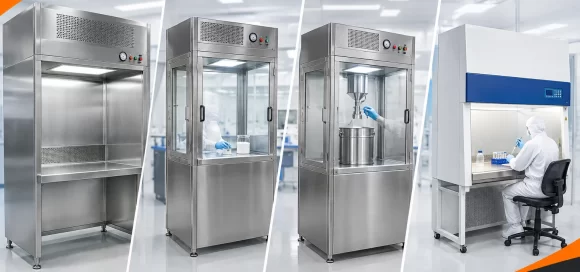
Most pharmaceutical plants shopping for RLAF Manufacturers in India, Sampling Booth Suppliers in India, Dispensing Booth Manufacturers in India, or Biosafety Cabinet Suppliers in India assume these are four separate purchases. In practice, the first three are often the same physical equipment wearing different names depending on where it sits in the process — and confusing that with a biosafety cabinet, which works on a completely different principle, is a common and expensive specification mistake.
This guide separates what’s actually the same equipment from what genuinely isn’t, and walks through what to check before placing an order with any manufacturer.
RLAF, Sampling Booth and Dispensing Booth: Same Equipment, Different Names
An RLAF unit pulls room air in through the front opening of the booth, passes it through pre-filters and then a HEPA filter stage, and either recirculates it or exhausts it — capturing dust and airborne particles at the source instead of letting them spread into the surrounding cleanroom. This reverse-flow principle is exactly the opposite of a standard laminar flow hood, which pushes filtered air out toward the operator to protect the product rather than pulling contaminated air away from the operator.
That single working principle covers three names you’ll see on the market:
- RLAF (Reverse Laminar Air Flow) — the generic engineering term for the unit itself
- Sampling Booth — the same RLAF unit installed where raw materials are sampled and tested before they’re approved for production
- Dispensing Booth — the same RLAF unit installed where raw materials are weighed out for batch manufacturing
So when you’re evaluating RLAF Manufacturers in India, Sampling Booth Suppliers in India, and Dispensing Booth Manufacturers in India, you’re largely evaluating the same manufacturing capability, applied to different rooms in the same facility. A manufacturer that builds a good sampling booth can almost always build a good dispensing booth, because the airflow engineering, filtration stages, and stainless steel fabrication requirements are essentially identical.
What genuinely differs between a sampling booth and a dispensing booth is the room layout around it — pass-through arrangements, bin or drum access, and how the booth interfaces with the rest of the material flow — not the core equipment design. Pragati Engineers’ RLAF product range covers all three configurations.
RLAF Manufacturers in India: What to Check
Before shortlisting RLAF manufacturers in India, get clear answers on:
- Filtration stages: a proper RLAF unit uses at least a pre-filter stage followed by HEPA filtration — confirm the HEPA grade and rated efficiency, not just that “HEPA filters are included”
- Airflow velocity: ask for the rated face velocity and whether it’s been validated, not just designed on paper
- Standalone operation: most RLAF units run entirely on their own power supply without depending on the facility’s central HVAC — confirm whether the unit you’re quoted needs any external ducting
- Construction material: stainless steel construction with no gaps or joints where particulate can collect is standard for GMP-oriented builds — ask specifically about weld finish and corner design
- Validation documentation: IQ/OQ protocols, filter integrity test reports, and airflow uniformity data should be part of the delivery, not an afterthought you have to chase down later
Sampling Booth Suppliers in India: Where It Gets Used
A sampling booth sits at the point where incoming raw materials are opened and tested before they’re released for use — one of the highest-risk contamination points in a pharmaceutical facility, since it’s the first place a container from outside the controlled environment gets opened. Sampling booth suppliers in India typically build to the same RLAF principle described above, but the room integration matters more here than on a standalone unit: confirm how the booth interfaces with your raw material store and whether the airflow direction is validated for your specific room pressure cascade.
Dispensing Booth Manufacturers in India: Where It Gets Used
A dispensing booth is installed in the weighing and dispensing area, where raw materials are measured out in the quantities needed for a specific batch. This is typically a higher-throughput environment than sampling, so dispensing booth manufacturers in India often build slightly larger working chambers with more robust filter-change access, since these units run for longer stretches during a production day. The core filtration and airflow principle is unchanged from the RLAF and sampling booth builds described above.
Biosafety Cabinet Suppliers in India: A Genuinely Different Equipment Category
This is where buyers most often go wrong: assuming a biosafety cabinet is just another name for RLAF or a laminar flow hood. It isn’t. A biosafety cabinet is built for a different job — protecting personnel, product, and the environment simultaneously when working with biological agents, not just containing dust from powders.
Biosafety cabinets fall into three classes, and the class you need depends entirely on what you’re handling:
- Class I — protects personnel and the environment through inward airflow, but does not protect the product itself. Suitable for general microbiological work where product sterility isn’t the concern.
- Class II — the type most pharmaceutical, clinical, and biotechnology facilities actually need. It adds HEPA-filtered vertical downflow on top of the inward airflow, so it protects personnel, product, and environment at the same time. Within Class II, Type A2 is by far the most common configuration and typically doesn’t require a hard-ducted exhaust connection, which makes it considerably easier and cheaper to install than Type B variants.
- Class III — a fully sealed, gas-tight enclosure with glove ports, used only for the highest-containment work. Overkill and unnecessarily expensive for standard pharmaceutical applications.
If your process involves any volatile or toxic chemical work alongside biological handling, a standard recirculating Class II cabinet isn’t appropriate — that needs a Type B configuration with hard-ducted exhaust, or a Class III enclosure. This is exactly the kind of detail that separates a biosafety cabinet supplier who understands pharmaceutical containment from one who’s simply repackaging a generic clean bench. Pragati Engineers’ biosafety cabinet product page has configuration details for our standard builds.
Buy Biosafety Cabinet in India: Questions to Ask Before You Order
- Which class and type do you actually need? Don’t let a supplier default you into whichever configuration they have in stock — the class decision should follow from your biosafety level and whether chemical vapors are involved.
- What’s the rated inflow velocity and HEPA efficiency? Get the certified numbers, not a general claim of “HEPA filtered.”
- Does the cabinet need a hard-ducted exhaust connection? This affects your installation cost and room layout significantly, and it’s a detail that should be confirmed before the cabinet arrives, not after.
- What validation and certification documentation is included? Airflow uniformity testing, filter integrity (DOP/PAO) test reports, and sound/vibration data should come standard.
- What’s the after-sales filter replacement and recertification support? Biosafety cabinets need periodic recertification — confirm the manufacturer or supplier can support this locally rather than requiring you to source it separately.
Why the Manufacturer’s In-House Fabrication Matters Here
All four of these equipment types — RLAF, sampling booths, dispensing booths, and biosafety cabinets — depend heavily on weld quality and stainless steel finish, because any gap or seam in the working chamber becomes a place where contamination can collect and where validated airflow patterns can be disrupted. A manufacturer that fabricates the stainless steel structure in-house, rather than buying a generic enclosure and bolting a filter unit onto it, has far more control over that finish.
Pragati Engineers fabricates pharmaceutical process and cleanroom equipment at its facility in Ambala Cantt, and has already supplied our Dynamic and Static Pass Box ranges into similar cleanroom access applications — the same GMP-oriented fabrication approach carries over to RLAF, sampling and dispensing booths, biosafety cabinets, and our broader cleanroom equipment range, including sterile garment cabinets for gowning areas adjacent to these zones.
Frequently Asked Questions
Is a sampling booth the same as an RLAF unit?
Yes, in most cases. A sampling booth is an RLAF unit installed at the raw-material sampling point. The underlying airflow and filtration principle is the same; what differs is the room integration around it.
Is a dispensing booth the same as a sampling booth?
They’re built on the same RLAF principle, but dispensing booths are typically sized and configured for the weighing and dispensing area rather than the sampling area, and may see higher daily throughput.
What’s the difference between RLAF and a biosafety cabinet?
RLAF systems are designed to contain dust and particulate generated during powder handling — they’re a contamination-control tool for materials, not biological agents. Biosafety cabinets are engineered specifically for working with biological agents and provide a different, class-specific combination of personnel, product, and environmental protection. The two should not be treated as interchangeable.
Which biosafety cabinet class do most pharmaceutical facilities need?
Class II, Type A2 covers the large majority of standard pharmaceutical, clinical, and cell-culture work. Only move to a Type B configuration or Class III enclosure if your process involves volatile or toxic chemical handling alongside biological agents.
Do RLAF units need to be connected to the facility’s central HVAC?
No — most RLAF units are designed to run independently on their own power supply, without depending on external ducting or the facility’s HVAC system. Confirm this specifically with your supplier if standalone operation matters for your installation.
Talk to Pragati Engineers About Cleanroom Access Equipment
Whether you’re comparing RLAF Manufacturers in India, Sampling Booth Suppliers in India, Dispensing Booth Manufacturers in India, or looking to buy a Biosafety Cabinet in India, share your room layout, throughput, and containment requirements with our engineering team. Contact Pragati Engineers to discuss your cleanroom access equipment requirements and request a quotation.