
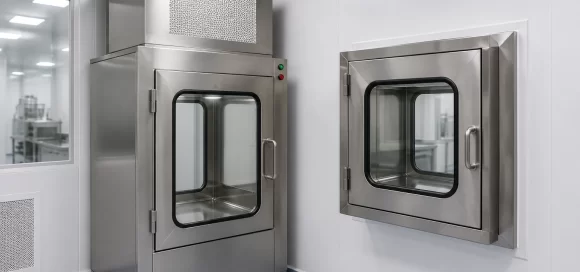
For pharmaceutical manufacturers, API producers, biotechnology facilities, and sterile product manufacturers, a pass box is one of the most frequently specified — and most frequently misspecified — items of clean room equipment. Choosing the wrong type for a given transfer point compromises clean room integrity, creates regulatory non-compliance, and can cause contamination events that result in batch rejection or failed inspections. This guide gives plant engineers, quality assurance managers, and purchase managers the technical grounding to make the correct selection between a dynamic pass box and a static pass box, and to specify each type correctly from manufacturers in India.
Pragati Engineers, based in Ambala, Haryana, has supplied clean room equipment for pharmaceutical and API plants since 1996. We manufacture both Dynamic Pass Boxes and Static Pass Boxes to GMP requirements, in SS304 and SS316, in four standard sizes with custom sizes available. View our full clean room equipment range for the complete product portfolio.
What Is a Pass Box and Why Is It Required in a Pharmaceutical Clean Room?
A pass box — also referred to as a transfer hatch or transfer box in some regulatory contexts — is a wall-mounted or partition-mounted enclosure with two interlocked doors, one on each side of the clean room wall or partition. Materials, components, and equipment required inside the clean room are placed into the pass box from the outside, the outer door is closed and interlocked, and then the inner door is opened to retrieve the items from inside the clean room. At no point can both doors be simultaneously open.
The fundamental purpose of this arrangement is to prevent unfiltered external air — carrying personnel-generated particles, microbial contamination, and environmental dust — from flowing directly into the classified clean room environment when materials are being transferred. Without a pass box, every material delivery into the clean room would require a personnel entry and exit cycle, creating a contamination introduction opportunity at each event and increasing personnel traffic in areas where minimising human activity is a core GMP principle.
GMP guidelines — including WHO GMP, CDSCO Schedule M, EU GMP Annex 1, and US FDA guidance for aseptic processing — require that material transfer points into and between classified clean room areas be designed to prevent contamination ingress. Pass boxes are the standard engineering solution for this requirement in the pharmaceutical industry.
For a broader reference on clean room and API plant equipment requirements, see our guide to pharmaceutical process equipment used in modern manufacturing plants.
Dynamic Pass Box: Working Principle and Specifications
A dynamic pass box is an active contamination control device. In addition to the electromagnetic interlocking door system that prevents simultaneous opening, the dynamic pass box is equipped with a HEPA filtration and blower assembly that generates a continuous filtered airflow within the transfer chamber. This airflow purges airborne particles that enter the chamber from the lower-grade side — the unclassified corridor or lower-classification area — before the clean room-side door is opened.
The mechanism works as follows. When the outer door is opened from the corridor side, ambient particles enter the chamber along with the material being loaded. The outer door is then closed. The HEPA-filtered blower system runs continuously — or is activated by a timer or door-closure signal — drawing air through the pre-filter and HEPA filter and discharging it into the chamber as a laminar or mixed flow of clean air at Class 100 (ISO 5) cleanliness. This purge cycle removes the particles introduced from the corridor before the inner door can be opened into the classified clean room.
Dynamic Pass Box Specifications — Pragati Engineers
| Parameter | Specification |
|---|---|
| Air Cleanliness Class | Class 100 (ISO 5) |
| Outer Dimensions | 600 × 600 × 600 mm (standard) |
| Available Sizes | 1.5’×1.5′, 2’×2′, 2.5’×2.5′, 3’×3′ |
| Material of Construction | SS 304 Stainless Steel |
| Filter Assembly | HEPA Filter + Pre-Filter |
| Blower Type | Centrifugal |
| Air Flow | 600 CFM |
| Door Type | Swing type with view panels |
| Interlocking System | Electromagnetic — prevents simultaneous opening |
| Additional Features | UV light, differential pressure monitoring |
| Compliance | GMP |
| Applications | Pharmaceutical, Biotechnology, Healthcare, Electronics, Research |
Static Pass Box: Working Principle and Specifications
A static pass box is a passive contamination control device. It has no blower, no filter assembly, and no active airflow. Its contamination control function is achieved entirely through the electromagnetic interlocking system that prevents both doors from being opened at the same time, thereby ensuring that the clean room interior is never directly exposed to the environment on the other side of the wall.
When the outer door is opened, materials are placed inside the chamber. The outer door is closed. The electromagnetic interlock then releases, allowing the inner door to be opened from the clean room side. Because both doors cannot be open simultaneously, there is no direct air pathway between the two environments. The chamber air is exchanged once — when the outer door opens and closes — but no active purging occurs. The clean room’s own air handling system and positive pressure cascade handle the dilution and removal of any particles introduced during the brief outer-door-open period.
This is why the static pass box is the correct choice only for transfer between areas of equal or similar classification — where both sides are already classified clean room zones maintained at similar ISO grades and the pressure differential between them manages contamination control. It is not appropriate for transfers between an unclassified corridor and a classified clean room.
Static Pass Box Specifications — Pragati Engineers
| Parameter | Specification |
|---|---|
| Outer Dimensions | 750 × 750 × 750 mm (standard) |
| Available Sizes | 1.5’×1.5′, 2’×2′, 2.5’×2.5′, 3’×3′ |
| Material of Construction | SS 304 or SS 316 Stainless Steel |
| Door Type | Double door |
| Interlocking System | Electromagnetic — prevents simultaneous opening |
| Mounting | Wall mounted |
| Brand | KleenFlo |
| Compliance | GMP |
| Filter / Blower | None — passive design |
| Applications | Pharmaceutical, Biotechnology, Healthcare, Food Processing, Research |
Dynamic Pass Box vs Static Pass Box: Full Comparison
| Feature | Dynamic Pass Box | Static Pass Box |
|---|---|---|
| Active Airflow / Filtration | Yes — HEPA + Pre-filter, 600 CFM centrifugal blower | No — passive design, no blower or filter |
| Air Cleanliness Achieved | Class 100 (ISO 5) inside chamber during purge | No independent classification — relies on room HVAC |
| Interlocking System | Electromagnetic | Electromagnetic |
| Material of Construction | SS 304 | SS 304 or SS 316 |
| Standard Outer Dimensions | 600 × 600 × 600 mm | 750 × 750 × 750 mm |
| UV Light | Yes | Not specified |
| Differential Pressure Monitoring | Yes | No |
| Correct Application | Transfer between unclassified / lower-grade area and classified clean room (Grade D, C, B) | Transfer between two areas of equal or similar clean room classification |
| GMP Requirement Addressed | Particle control at classification boundary — active purge before inner door opens | Prevention of direct air exchange — physical barrier only |
| Power Requirement | Yes — blower motor and controls | Minimal — electromagnetic lock only |
| Relative Cost | Higher — active filtration system | Lower — passive construction |
| Typical Pharma Location | Corridor-to-clean room boundary, change room to production area | Between Grade D and Grade D areas, between equal clean room zones |
GMP Requirements for Pass Boxes in Pharmaceutical Manufacturing
Pass boxes used in pharmaceutical clean rooms must meet specific GMP requirements that go beyond basic construction quality. Engineers and quality managers specifying pass boxes for regulated pharmaceutical facilities should confirm the following with their supplier:
- Electromagnetic interlocking: Both WHO GMP and EU GMP Annex 1 require that transfer hatches have an interlock system preventing both doors from opening simultaneously. Mechanical interlocks are considered less reliable than electromagnetic systems for pharmaceutical applications.
- Material compatibility: Internal surfaces must be smooth, non-shedding, and resistant to the cleaning agents and disinfectants used in the facility. SS304 is acceptable for most clean room environments. SS316 provides superior resistance to chloride-bearing disinfectants and is preferred for sterile manufacturing and injectable product areas.
- HEPA filter integrity: For dynamic pass boxes, the HEPA filter must meet the required efficiency classification (H14 for Class 100 / ISO 5 performance) and must be tested and certified at the factory. Differential pressure monitoring across the filter enables in-use monitoring of filter loading and alerts maintenance when the filter requires replacement.
- UV lamp provision: UV lamps provide supplementary surface decontamination within the transfer chamber. They do not replace chemical disinfection but provide an additional layer of contamination control between cleaning cycles. The dynamic pass box from Pragati Engineers includes a UV light as standard.
- Cleanability: The interior of the pass box must be free of crevices, sharp corners, and inaccessible areas that trap contamination. All welds should be ground smooth and the internal finish should be consistent with the clean room classification being served.
How to Select the Right Pass Box for Each Transfer Point in Your Clean Room
The correct selection of pass box type for each material transfer point in a pharmaceutical clean room is determined by three factors: the ISO classification of each area on either side of the transfer point, the direction of the pressure cascade between those areas, and the nature of the materials being transferred.
- Unclassified corridor → Classified clean room (Grade D / ISO 8 or better): Always specify a dynamic pass box. The active HEPA purge cycle removes particles introduced from the unclassified side before the classified room-side door opens. A static pass box is inadequate at this boundary.
- Grade D → Grade D (equal classification): A static pass box is appropriate where both areas are maintained at the same ISO classification and the room HVAC system maintains adequate positive pressure and air change rates on both sides.
- Grade D → Grade C or Grade B: A dynamic pass box is required. The step up in classification at this boundary means the higher-grade room must be protected from particles that may be present even in the lower-grade classified zone.
- Materials with surface contamination risk: Where the materials being transferred carry surface contamination — outer packaging, containers from uncontrolled storage — a dynamic pass box with UV lamp provides an additional decontamination step at the transfer point.
Complete Clean Room Equipment Range from Pragati Engineers
Pass boxes are one component of a complete pharmaceutical clean room equipment package. Pragati Engineers manufactures the full range of clean room equipment for pharmaceutical and API plants, including:
- Laminar Air Flow Units: Vertical LAF, Horizontal LAF, Ceiling Suspended LAF, Reverse LAF, and Mobile Trolley LAF — for workstation-level particle control in weighing, dispensing, and processing areas.
- Cleanroom Air Shower: Personnel air showers at clean room entry points remove particle contamination from gowns before personnel enter classified areas.
- Biosafety Cabinets: Biosafety cabinets for microbiological containment in microbiology laboratories and sterile manufacturing environments.
- Sterile Garment Cabinet: Sterile garment storage cabinets for gowning room management in sterile manufacturing areas.
- Fume Hoods: Chemical fume hoods for laboratory and production areas handling hazardous or volatile chemical compounds.
For API and bulk drug manufacturing plants, this clean room equipment connects to the broader process equipment chain covered in our guide to API equipment in India.
Engineer’s Buying Checklist: Pass Box Specification Points
Before placing an order for pass boxes with any manufacturer in India, confirm the following specification points in writing.
- What is the ISO classification of the clean room on each side of the transfer point — and which type of pass box does this require?
- What are the dimensions of the largest item that will be transferred through the pass box — this determines the required internal chamber size?
- What material of construction is required — SS304 or SS316 — based on the disinfectants and cleaning agents used in the facility?
- Is UV lamp provision required as part of the supply scope?
- Is differential pressure monitoring required on the dynamic pass box HEPA filter?
- What HEPA filter efficiency classification (H13 or H14) is required for the dynamic pass box to meet the clean room classification?
- What documentation is required — FAT certificate, HEPA filter test certificate, material certificate, GMP compliance declaration?
- What is the wall thickness at the installation point — this determines the tunnel depth of the pass box and must be confirmed before manufacture?
Get a Quote for Pass Boxes and Clean Room Equipment
Share your clean room layout, ISO classification requirements, transfer point locations, and material size requirements with our team. We will recommend the correct pass box type for each transfer point and provide a quotation for the complete supply. Dynamic pass boxes, static pass boxes, and the full range of pharmaceutical clean room equipment are available from stock and in custom sizes.
Dynamic Pass Box: View product page
Static Pass Box: View product page
Full Clean Room Range: Browse all clean room equipment
Call us: +91-9896008557 / +91-7496970799
Email: pragati@pragatiengineers.com
Address: No. 87, Industrial Estate, Ambala Cantt, Ambala – 133 006, Haryana, India
Frequently Asked Questions
What is the difference between a dynamic pass box and a static pass box?
A dynamic pass box has a HEPA filtration and blower system that actively purges particles from the transfer chamber during the transfer cycle, achieving Class 100 (ISO 5) cleanliness inside the chamber. It is used at boundaries between unclassified areas and classified clean rooms. A static pass box has no active airflow — its only contamination control mechanism is the electromagnetic interlock that prevents both doors from opening simultaneously. It is used between areas of equal or similar clean room classification.
When should I specify a dynamic pass box instead of a static pass box?
Specify a dynamic pass box when the transfer point is at a boundary between an unclassified area (corridor, warehouse, general production area) and a classified clean room (Grade D, C, or B). Specify a static pass box when both sides of the transfer point are already classified at the same or similar ISO grade and the room HVAC system maintains adequate particle control and positive pressure on both sides.
What air cleanliness class does the Pragati Engineers dynamic pass box achieve?
The dynamic pass box from Pragati Engineers achieves Class 100 (ISO 5) air cleanliness inside the transfer chamber, produced by a HEPA and pre-filter assembly with a centrifugal blower delivering 600 CFM of filtered airflow.
What material is used for the pass boxes at Pragati Engineers?
The dynamic pass box is manufactured in SS 304. The static pass box is available in SS 304 or SS 316, with SS 316 specified for sterile manufacturing and injectable product environments where superior corrosion resistance to chloride-bearing disinfectants is required.
What sizes are available?
Both dynamic and static pass boxes are available in 1.5’×1.5′, 2’×2′, 2.5’×2.5′, and 3’×3′ standard sizes. Custom dimensions are available based on clean room layout and material transfer requirements.
Is electromagnetic interlocking required under GMP guidelines?
Yes. WHO GMP, CDSCO Schedule M, and EU GMP Annex 1 all require that transfer hatches into or between classified clean room areas prevent both doors from opening simultaneously. Electromagnetic interlocking is the standard mechanism for pharmaceutical applications and is fitted as standard on both the dynamic and static pass boxes supplied by Pragati Engineers.
Can the same pass box be used in food processing and pharmaceutical clean rooms?
Yes. Pass boxes manufactured to GMP pharmaceutical standards — in SS304 or SS316 with electromagnetic interlocking and smooth cleanable internal surfaces — are equally suitable for food processing, nutraceutical, biotechnology, and electronics clean room facilities.
What other clean room equipment should be specified alongside pass boxes?
A complete pharmaceutical clean room typically also requires laminar air flow units, a cleanroom air shower at personnel entry points, biosafety cabinets for microbiology and sterile areas, and sterile garment cabinets for gowning rooms. Pragati Engineers manufactures all of these as part of its complete clean room equipment range.