
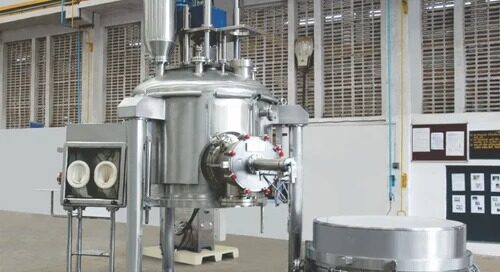
If you work in an API or bulk drug plant, you will hear the term ANFD often. The ANFD full form is Agitated Nutsche Filter Dryer. It is a single closed vessel that filters a slurry, washes the cake and dries it, so the product never has to be moved between machines. In this guide we explain how an ANFD works, its main parts, the design points that matter and how it compares with other equipment.
Quick answer: ANFD stands for Agitated Nutsche Filter Dryer. It combines filtration, cake washing and vacuum drying in one enclosed unit, which reduces product loss, operator exposure and contamination risk in pharmaceutical and chemical processing.
What Is an ANFD?
An ANFD (Agitated Nutsche Filter Dryer) is a closed pressure vessel with a filter plate at the bottom and an agitator that can move up and down inside. It is used where a solid product has to be separated from its mother liquor, washed and dried, which is a very common sequence in API and intermediate manufacturing.
Earlier, this took three separate machines: a filter or centrifuge, a dryer and manual cake handling in between. The ANFD does all three jobs in one vessel. That is why it is widely used for potent, toxic or solvent-wet products where open handling is a risk.
ANFD Working Principle: Step by Step
- Charging: the slurry from the reactor or crystallizer is transferred into the closed ANFD vessel.
- Filtration: pressure (nitrogen or air) or vacuum pushes the liquid through the filter medium at the bottom. The solids stay on the plate and form a cake.
- Cake washing: wash solvent is added and the cake is washed to remove impurities. The agitator can be used to re-slurry the cake for a more even wash.
- Smoothing: the agitator is lowered to level the cake and close any cracks, so that the gas or wash liquid does not take a short route.
- Drying: heat from the jacket (and in some designs the agitator) with vacuum removes the remaining solvent. The agitator turns the cake gently to dry it evenly.
- Discharge: the dried product is pushed out through a discharge port, either by lowering the agitator or with a side discharge valve, directly into a drum, liner or the next unit.
Main Parts of an ANFD
- Vessel with jacket: holds the slurry and cake. The jacket carries steam, hot water or thermic fluid for drying, or cooling fluid where needed.
- Filter plate and medium: a perforated or sintered plate covered with filter cloth or mesh. It retains the solids and lets the liquid pass.
- Agitator: moves up, down and rotates. It levels, turns and discharges the cake.
- Agitator drive and seal: a gear motor with a mechanical seal that keeps the vessel closed and leak-tight.
- Lifting mechanism: a hydraulic or mechanical system to raise and lower the agitator.
- Discharge valve: opens for sealed product discharge.
- Vacuum and pressure connections: for filtration, drying and inert gas supply.
ANFD Design: What to Check
Filtration area and cake height
The filter area decides how fast your slurry is filtered, and the usable cake height decides how much product a batch can hold. Design them from your actual batch size and cake properties, not from a catalogue figure.
Material of construction
Product-contact parts are usually SS 316L. For corrosive products or acidic solvents, Hastelloy or other special alloys are used. Surface finish matters in pharma because it affects cleaning and cross-contamination.
Agitator design
The blade shape, clearance from the filter plate and the ability to reverse direction affect how well the cake is smoothed, dried and discharged. Poor clearance leaves a heel of product behind.
Sealing and containment
A good mechanical seal and tight gaskets are needed for solvent-wet and potent materials. If the product is hazardous, discuss isolators or closed charging and discharge systems at the design stage.
Heating and drying capacity
Drying time depends on the jacket area, the heating medium, the vacuum level and the cake properties. Share the solvent and the target residual solvent limit with your supplier.
Cleaning and validation
Look for smooth welds, minimal dead legs and easy access, and ask for the documents your validation team will need.
Advantages and Limitations of ANFD
Advantages
- Filtration, washing and drying in one closed vessel
- Lower product loss and fewer transfers
- Less operator exposure to solvents and potent powders
- Better control of contamination and solvent emissions
- Smaller floor space than separate filter and dryer lines
Limitations
- Drying can be slower than in a dedicated dryer for some products
- Cake cracking or channelling needs good agitator control
- Very fine or sticky solids may blind the filter medium
- Higher initial cost than a simple nutsche filter
ANFD vs Other Filtration and Drying Equipment
| Equipment | What it does | Best for |
|---|---|---|
| ANFD | Filters, washes and dries in one closed vessel | API and intermediates, potent or solvent-wet products |
| Nutsche filter (non-agitated) | Filters and washes only | Simple separation where drying is done elsewhere |
| Centrifuge | Spins out liquid at high speed | Fast separation of free-flowing crystals |
| Vacuum tray dryer | Dries the cake on trays under vacuum | Heat-sensitive products, small batches |
| Rotary vacuum paddle dryer | Dries the powder in a paddle-agitated vessel | Bulk drying with good mixing |
In many plants, an ANFD replaces the centrifuge and tray dryer combination for a given product. The right choice depends on crystal size, filtration rate, solvent and batch size.
Where ANFD Is Used
- API and bulk drug manufacturing
- Intermediates and fine chemicals
- Agrochemicals and dyes
- Any process with solvent-wet, toxic or potent solids
An ANFD usually sits after the reactor or crystallizer and works with a solvent recovery plant that condenses and recovers the solvent removed in washing and drying. See our full range of API equipment for the complete line.
How to Choose an ANFD Supplier in India
- Experience with your product type: ask for similar installations.
- Design from your data: batch size, slurry solids, solvent and drying limit.
- Fabrication quality: weld finish, agitator alignment and surface finish.
- Testing and documents: drawings, material certificates and test reports.
- After-sales support: spares for seals, filter media and agitator parts.
Looking for ANFD manufacturers in India? Pragati Engineers builds ANFD systems to your process data. For more on choosing a supplier, read how to choose the right pharmaceutical equipment manufacturer in India.
ANFD FAQs
What is the full form of ANFD?
ANFD stands for Agitated Nutsche Filter Dryer.
What is an ANFD used for in pharma?
It is used to filter, wash and dry solid products such as APIs and intermediates in a single closed vessel.
What is the difference between a nutsche filter and an ANFD?
A nutsche filter only filters and washes. An ANFD adds an agitator and a heated jacket with vacuum so it can also dry the cake in the same vessel.
What materials are used for ANFD construction?
Product-contact parts are commonly SS 316L. Hastelloy and other alloys are used for corrosive products.
Can an ANFD replace a centrifuge and dryer?
For many products, yes. It depends on the product, the crystal size and the drying requirement.
How do I get a quote for an ANFD?
Share your batch size, solvent, material and drying limit through our contact page and we will send a technical offer.
Need an ANFD for Your Plant?
Tell us your product, batch size and solvent, and we will design and quote it. See our ANFD range or get a quote.