
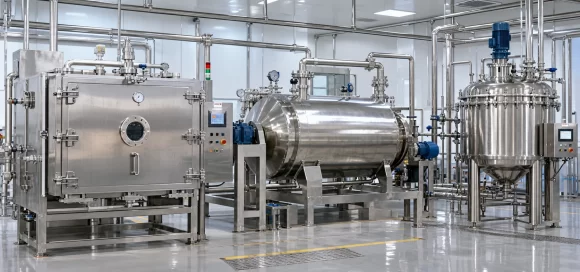
Drying is one of the slowest and most critical steps in API and chemical manufacturing. The dryer you pick decides your batch time, residual solvent level, product quality and operator safety. Three types are used most often in India: the vacuum tray dryer (VTD), the rotary vacuum paddle dryer (RVPD) and the agitated nutsche filter dryer (ANFD). This guide compares them so you can choose the right one for your product.
Quick answer: Use a vacuum tray dryer for small batches of heat-sensitive products. Use a rotary vacuum paddle dryer for bulk drying of free-flowing or slightly sticky powders with good mixing. Use an ANFD when you also want to filter and wash the cake in the same closed vessel.
Vacuum Tray Dryer (VTD)
A vacuum tray dryer is a closed chamber with heated shelves. The wet product is spread on trays, the chamber is evacuated, and heat from the shelves (hot water, steam or thermic fluid) removes the solvent at a low temperature. Many plants simply call it a VTD dryer.
Strengths
- Gentle drying at low temperature, good for heat-sensitive products
- No agitation, so crystals are not broken
- Simple design, easy to operate and validate
- Good for small and medium batches and for many different products in one plant
Limitations
- Trays are loaded and unloaded by hand, which creates exposure and contamination risk with potent or toxic products
- Drying is slow because the product bed is not mixed
- Lumps and uneven drying can occur, so the product may need to be milled afterwards
- Labour needs rise as batch size grows
For potent products, VTDs are often paired with isolators or contained loading systems. See our vacuum tray dryer manufacturers in India page or the vacuum tray dryer product page.
Rotary Vacuum Paddle Dryer (RVPD)
A rotary vacuum paddle dryer is a horizontal, jacketed vessel with a slow-turning shaft fitted with paddles. The product is loaded into the vessel, heated through the jacket under vacuum, and mixed continuously by the paddles. The mixing speeds drying and keeps the temperature even.
Strengths
- Faster drying than a tray dryer because the product is constantly turned
- More even drying with fewer lumps
- Closed system with sealed charging and discharge, so less operator exposure
- Less labour and a smaller footprint for the same output
Limitations
- Agitation can break fragile crystals
- Very sticky or paste-like materials may build up on the walls
- Higher cost than a tray dryer
- Cleaning between products needs more effort than a tray dryer
Read more on our rotary vacuum paddle dryer page, which also covers design and sizes.
Agitated Nutsche Filter Dryer (ANFD)
An ANFD is a closed vessel that filters the slurry, washes the cake and then dries it using vacuum, a heated jacket and an agitator that lowers into the cake. It replaces a filter, a dryer and the manual transfer between them. Learn the working in detail in our guide to the ANFD full form, working principle and design.
Strengths
- Filtration, washing and drying in one place, with no cake transfer
- Best containment for toxic, potent or solvent-wet products
- Fewer pieces of equipment to clean and validate
Limitations
- Drying is usually slower than in a dedicated paddle dryer
- Filter medium can blind with very fine solids
- Not the best use of expensive equipment if you only need drying
Find our ANFD manufacturers in India page for details.
VTD vs RVPD vs ANFD: Comparison
| Factor | Vacuum tray dryer | Rotary vacuum paddle dryer | ANFD |
|---|---|---|---|
| Main function | Drying | Drying | Filtration, washing and drying |
| Agitation | None | Paddle agitator | Agitator that moves into the cake |
| Drying speed | Slow | Fast | Moderate |
| Crystal damage | Very low | Possible | Possible |
| Containment | Low without isolators | Good | Very good |
| Labour | High | Low | Low |
| Best batch size | Small to medium | Medium to large | Small to large |
| Cost | Lowest | Medium to high | High |
How to Choose the Right Dryer
- Check heat sensitivity: if the product degrades easily, a VTD at low temperature is often the safest choice.
- Check crystal strength: fragile crystals do better in a tray dryer than in an agitated dryer.
- Check toxicity and potency: highly potent products need closed handling, which favours an RVPD or ANFD (or a VTD with an isolator).
- Check batch size and frequency: larger and more frequent batches justify an agitated dryer.
- Check the solvent and the residual limit: your target LOD or residual solvent level sets the drying time you need.
- Check whether filtration is also needed: if yes, an ANFD may remove a centrifuge and a dryer from your line.
- Plan solvent recovery: a solvent recovery plant saves solvent and reduces emissions from any vacuum dryer.
Common Mistakes to Avoid
- Buying a dryer based on price alone, without checking the product’s behaviour on drying
- Ignoring the vacuum pump and condenser size, which control drying speed
- Not asking for trial or reference data for a similar product
- Forgetting cleaning and validation needs when changing products often
Pragati Engineers supplies drying and filtration equipment as part of complete API equipment lines, built to your process data.
Frequently Asked Questions
What is the difference between a vacuum tray dryer and a rotary vacuum paddle dryer?
A vacuum tray dryer dries the product on static trays, while a rotary vacuum paddle dryer stirs the product in a closed vessel, which dries it faster and more evenly.
Which dryer is best for heat-sensitive products?
A vacuum tray dryer is often chosen because it works at low temperature without agitation.
Can an ANFD replace a vacuum tray dryer?
For many products, yes, especially when you also filter and wash the cake. It depends on the product and the drying limit.
What does VTD stand for?
VTD stands for vacuum tray dryer.
What does RVPD stand for?
RVPD stands for rotary vacuum paddle dryer.
How do I get a quote for a dryer?
Send your product, solvent and batch size through our contact page.
Need Help Choosing a Dryer?
Tell us your product and batch size, and we will recommend the right dryer. See our rotary vacuum paddle dryer, vacuum tray dryer or get a quote.