
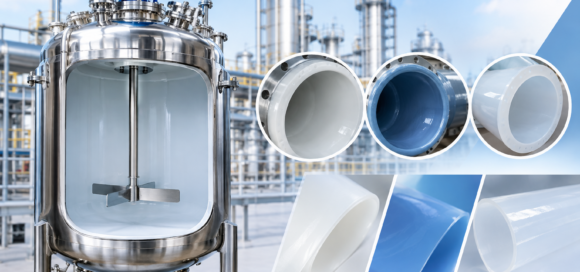
If you’re searching for Halar Coated Equipment Manufacturers in India, ETFE Coated Equipment Suppliers in India, or PFA Coated Equipment Manufacturers in India, the first decision isn’t which vendor to call — it’s which coating actually fits your process. Choosing a fluoropolymer coating for pharmaceutical or chemical process equipment is not simply a matter of picking the coating with the highest chemical resistance. Halar, ETFE and PFA each offer different combinations of chemical resistance, temperature capability, mechanical durability, permeability and processing characteristics.
The right choice depends on what the equipment will actually face during operation: the chemicals involved, their concentration, operating temperature, pressure, mechanical exposure, cleaning method and required purity level. Selecting a coating based only on availability or price can create problems later, including premature wear, blistering, delamination, contamination or reduced equipment life.
This guide compares Halar (ECTFE), ETFE and PFA coatings and explains where each option fits on pharmaceutical and chemical process equipment in India — and points you to the right manufacturer or supplier for each.
Why Is Fluoropolymer Coating Used on Process Equipment?
Stainless steel is widely used for pharmaceutical and chemical process equipment because of its strength, cleanability and corrosion resistance. However, stainless steel is not suitable for every chemical combination or operating condition. Certain acids, alkalis, solvents and aggressive process chemicals can attack stainless steel, particularly when concentration and temperature increase.
One solution is to manufacture the complete equipment from a highly corrosion-resistant alloy such as Hastelloy. Another approach is to use a suitable stainless steel substrate with a chemically resistant fluoropolymer coating or lining.
For tanks, reactors, process vessels, pipe components, valve bodies and other equipment, a correctly selected fluoropolymer coating can provide a protective barrier between the process media and the underlying metal. The coating option, however, must be selected according to the actual process conditions rather than treated as a universal corrosion solution.
Three materials commonly considered for demanding applications are:
- Halar (ECTFE) – valued for chemical resistance, barrier performance and relatively thick protective linings.
- ETFE – valued for chemical resistance combined with toughness and resistance to mechanical wear.
- PFA – valued for high-temperature capability, chemical resistance and low-permeability fluoropolymer barriers.
Halar Coated Equipment Manufacturers in India
Halar is the trade name commonly associated with ECTFE (ethylene chlorotrifluoroethylene). It is used as a protective fluoropolymer coating where resistance to aggressive chemicals and good barrier performance are important, and it’s one of the most frequently requested coatings among pharmaceutical and chemical equipment manufacturers in India.
One of its advantages is that ECTFE can be applied in relatively substantial coating thicknesses. Depending on the equipment, coating system and application requirements, thicker builds can provide useful protection against chemical permeation and mechanical damage.
Where Halar Coating Can Be a Good Fit
- Equipment exposed to many aggressive acids and alkalis
- Chemical and pharmaceutical process vessels
- Pipe spools, fittings and transfer components
- Storage and mixing equipment
- Agitator components where chemical exposure is a concern
- Applications where barrier performance and coating thickness are important
- Selected high-purity process applications using an appropriate grade and validated system
ECTFE also offers good mechanical toughness and can be useful where the coating needs to withstand routine handling and maintenance. However, chemical compatibility must always be checked against the actual process media, concentration and operating temperature. No fluoropolymer should be selected simply because it performs well against a broad category of chemicals.
For example, compatibility can change significantly with temperature, concentration and exposure time. The final specification should therefore be based on documented chemical-resistance data and the equipment manufacturer’s application recommendations.
Pragati Engineers manufactures a Halar coated agitated vessel for applications requiring this level of chemical resistance and barrier performance.
ETFE Coated Equipment Suppliers in India
ETFE (ethylene tetrafluoroethylene) is another fluoropolymer used for protecting process equipment from aggressive chemical environments. Its key advantage is the combination of chemical resistance, toughness and resistance to mechanical wear. When comparing ETFE coated equipment suppliers in India, ask specifically about film build and abrasion testing, since that’s where ETFE is meant to outperform the alternatives.
This makes ETFE particularly interesting for equipment or components where the coating is exposed to physical stress in addition to chemical attack.
Typical ETFE Coated Equipment Applications
- Pump and valve components
- Agitator and mixing components
- Storage tank interiors
- Chutes and material-handling surfaces
- Process components exposed to repeated mechanical contact
- Equipment handling abrasive or mechanically demanding process media
ETFE is not necessarily the best choice simply because it is mechanically tough. The process temperature, chemical composition and required purity still need to be evaluated. For applications operating at higher temperatures, PFA may provide a more suitable operating window.
A practical way to compare Halar and ETFE is to look at the dominant risk. If chemical barrier performance and the required coating build are major considerations, Halar may be worth evaluating. If mechanical toughness and resistance to physical wear are more important, ETFE may be a better candidate.
PFA Coated Equipment Manufacturers in India
PFA (perfluoroalkoxy) is widely used where a combination of high chemical resistance, high-temperature capability and a low-permeability fluoropolymer barrier is required. Among PFA coated equipment manufacturers in India, film continuity and grade documentation are what separate a genuine chemical barrier from a coating that only looks the part.
Unlike conventional PTFE-based spray systems, PFA can be processed into a continuous melt-flow coating. When properly specified and applied, it can provide a highly continuous protective barrier with very low permeability.
This makes PFA particularly useful in demanding pharmaceutical, chemical and high-purity applications where chemical exposure, cleaning conditions and contamination control are important.
Where PFA Coating Can Be a Good Fit
- Higher-temperature chemical processing applications
- Pharmaceutical process equipment requiring aggressive cleaning
- Valves, probes and other process-contact components
- Equipment handling highly aggressive chemicals
- High-purity process systems where extractables and leachables need to be controlled
- Applications where a continuous, low-permeability fluoropolymer barrier is required
PFA generally carries a higher material and processing cost than many alternative fluoropolymer coating options. That additional cost can be justified when the application requires its particular combination of temperature capability, chemical resistance and barrier performance.
For pharmaceutical equipment, buyers should also verify the specific PFA grade, coating system and documentation rather than assuming that the word “PFA” by itself guarantees regulatory compliance. Product-contact requirements should be supported by appropriate material and finished-equipment documentation.
Halar vs ETFE vs PFA: Key Differences
Whether you’re comparing Halar coated equipment manufacturers, ETFE coated equipment suppliers, or PFA coated equipment manufacturers in India, this table is a useful starting point for narrowing down which coating fits your process before you request quotes.
| Property | Halar (ECTFE) | ETFE | PFA |
|---|---|---|---|
| Main strength | Chemical resistance and barrier performance | Toughness and mechanical wear resistance | High-temperature chemical resistance and low permeability |
| Temperature capability | Suitable for moderate-temperature applications; grade and system dependent | Suitable for moderate-temperature applications; grade and system dependent | Suitable for higher-temperature applications; grade and system dependent |
| Chemical resistance | Excellent against many aggressive chemicals | Excellent against many aggressive chemicals | Excellent against a broad range of aggressive chemicals |
| Mechanical durability | Good | Very good for demanding mechanical environments | Good; application dependent |
| Barrier performance | Strong, particularly with suitable coating thickness | Strong | Very strong when properly applied |
| High-purity applications | Suitable for selected applications and grades | Suitable where chemical and mechanical requirements allow | Often preferred for demanding high-purity applications |
| Relative cost | Moderate to high depending on system | Moderate to high depending on system | Generally higher |
Note: Actual temperature limits, chemical compatibility and coating thickness depend on the specific resin grade, substrate, application process and operating conditions. Final selection should be confirmed against the manufacturer’s technical data.
Which Coating Should You Choose?
There is no single coating that is automatically best for every pharmaceutical or chemical process. The selection should start with the process conditions.
| If Your Main Requirement Is… | Coating to Evaluate |
|---|---|
| Strong chemical barrier performance at moderate temperatures | Halar (ECTFE) |
| Mechanical toughness and resistance to physical wear | ETFE |
| Higher operating temperature | PFA |
| Demanding high-purity process conditions | PFA or suitable high-purity ECTFE system |
| Aggressive chemicals with moderate mechanical exposure | Halar or PFA, depending on chemistry and temperature |
| Mechanical contact or abrasive exposure | ETFE may be worth evaluating |
This table should be treated as a starting point, not a substitute for chemical compatibility testing. The same chemical can behave differently at different concentrations and temperatures, so the final specification should be based on the complete process envelope.
Coating Selection Should Start With Process Conditions
Before asking a manufacturer for Halar, ETFE or PFA coated equipment, prepare the process information that will influence the coating selection.
1. Identify the Process Chemicals
Provide the manufacturer with the actual chemicals, mixtures and solvents that will contact the coated surface. If possible, include concentration and exposure time rather than only the chemical name.
2. Define the Operating Temperature
Temperature can significantly affect fluoropolymer performance and chemical compatibility. Provide normal operating temperature as well as expected minimum and maximum temperatures, including cleaning cycles.
3. Consider Mechanical Exposure
Agitation, abrasion, repeated movement, impact and material handling can affect coating life. Components exposed to mechanical wear may require a different coating strategy from a static vessel wall.
4. Specify the Required Coating Thickness
Coating thickness should be selected according to the application rather than simply choosing the thickest available coating. The required thickness can depend on chemical exposure, substrate geometry, permeation requirements and the coating process.
5. Consider Cleaning and CIP Conditions
Pharmaceutical equipment may experience repeated cleaning cycles involving chemicals, elevated temperatures and mechanical action. These conditions should be included when evaluating the coating system.
6. Define Product-Contact and Regulatory Requirements
If the coated surface will contact a pharmaceutical product or process stream, discuss material grade, documentation, extractables and leachables requirements, cleaning validation considerations and any applicable regulatory requirements with the equipment manufacturer.
Where Are Halar, ETFE and PFA Coatings Used?
Coating requirements can vary significantly between different components of the same process line. A vessel, agitator, valve and transfer pipe may face different combinations of chemical and mechanical exposure.
- Reactors and reactor internals: Selection depends on the reaction chemistry, temperature, agitation and required product purity. See our SS reactor buying guide for the uncoated baseline most plants compare against, or browse our SS reactor product range directly.
- Agitators and mixing components: Mechanical wear and chemical exposure both need to be considered.
- Valve bodies and process fittings: PFA may be considered where chemical resistance, temperature and product-contact requirements are demanding.
- Pipe spools, transfer lines and heat exchangers: The chemical composition, flow conditions and operating temperature influence coating selection. Our heat exchanger buying guide covers material selection for thermal equipment on the same process line.
- Storage and mixing tanks: Coating requirements depend on the stored material, cleaning process and mechanical exposure.
- Drying and filtration equipment: Some corrosive-media applications call for coated internals on drying or filtration systems as well — see our guides to ANFD manufacturers and vacuum tray dryers for equipment-level detail, or our vacuum tray dryer product page directly.
- Sensors and probes: Protective fluoropolymer systems can be considered for components exposed directly to aggressive process media.
For applications involving solvent handling and recovery, coating selection should also be evaluated alongside the complete process design. Our solvent recovery plant guide explains the equipment and process considerations involved in solvent recovery systems.
How to Choose a Coated Equipment Manufacturer or Supplier in India
Choosing the correct fluoropolymer is only one part of the specification. The quality of the substrate fabrication, surface preparation, coating application and inspection can have a major effect on equipment performance — and this is true whether you’re vetting Halar coated equipment manufacturers, ETFE coated equipment suppliers, or PFA coated equipment manufacturers in India. For the broader manufacturer-vetting process beyond coatings specifically, see our guide on how to choose the right pharmaceutical equipment manufacturer in India.
Before placing an order, ask the manufacturer about the following:
- Base material: Confirm the stainless steel or other substrate grade used to fabricate the equipment.
- Surface preparation: Ask how the substrate is cleaned, prepared and treated before coating.
- Coating grade: Confirm the exact fluoropolymer grade and whether it is suitable for the intended process.
- Coating thickness: Obtain the specified thickness range and acceptance criteria.
- Application process: Understand how the coating is applied and cured.
- Holiday or pinhole testing: Confirm how the finished coating is inspected for defects that could expose the substrate.
- Adhesion and visual inspection: Ask what quality checks are performed before dispatch, where applicable.
- Weld quality: Check whether the underlying vessel or component has been fabricated and inspected appropriately before coating.
- Dimensional inspection: Confirm that coating thickness and application will not compromise critical dimensions, clearances or component fit.
- Documentation: Request material certificates, coating details, inspection records and applicable compliance documentation.
- Repair procedure: Understand how coating damage will be identified and repaired during the equipment’s service life.
Why the Equipment Manufacturer Matters
A coated reactor or process vessel is not simply a standard vessel with a layer of fluoropolymer added at the end. The substrate design, weld quality, surface preparation, geometry, coating thickness and inspection process all influence the finished equipment.
Working with a manufacturer that understands both equipment fabrication and coating requirements can make communication easier because the fabrication and coating specifications can be considered together.
Pragati Engineers manufactures pharmaceutical and chemical process equipment at its facility in Ambala Cantt, Haryana. The company works with process equipment such as reactors, tanks and other fabricated systems, allowing coating requirements to be considered alongside the underlying equipment design.
For plants comparing coated construction with conventional stainless steel equipment, our SS reactor buying guide explains important considerations when selecting stainless steel reactors for pharmaceutical and chemical applications.
Halar vs ETFE vs PFA: Frequently Asked Questions
Is Halar or PFA better for pharmaceutical equipment?
Neither is universally better. Halar can be a strong option when chemical resistance and barrier performance at moderate temperatures are important, while PFA may be preferred when higher temperature capability, low permeability or demanding high-purity requirements are priorities. The final choice should be based on the actual process chemistry, temperature, cleaning conditions and regulatory requirements.
What is the difference between Halar and ETFE coating?
Both are fluoropolymers used for corrosion-resistant equipment, but their strengths differ. Halar (ECTFE) is often selected for its chemical resistance and barrier performance, while ETFE is valued for its combination of chemical resistance, toughness and mechanical wear resistance. The correct choice depends on the process conditions and coating system.
Is PFA better than Halar for high-temperature applications?
PFA generally offers a higher continuous-use temperature range than Halar, making it a coating worth evaluating for higher-temperature applications. However, the actual temperature limit depends on the specific material grade, coating system and process conditions.
Can ETFE be used for pharmaceutical process equipment?
Yes, ETFE can be considered for pharmaceutical process equipment when its chemical compatibility, temperature capability, mechanical properties and product-contact requirements are appropriate for the application. The specific grade and finished coating documentation should be verified before use.
How do I select the right coating thickness?
Coating thickness should be determined from the process chemistry, operating conditions, substrate, equipment geometry, permeation requirements and mechanical exposure. A coating should not be specified solely by choosing the maximum available thickness. The equipment and coating manufacturer should recommend the appropriate thickness for the specific application.
Is fluoropolymer coated equipment cheaper than Hastelloy equipment?
In many applications, coating a suitable stainless steel substrate can be more economical than manufacturing the complete vessel from a nickel alloy such as Hastelloy. However, the cost comparison depends on equipment size, alloy grade, coating system, fabrication requirements and expected service conditions.
Talk to Pragati Engineers About Coated Process Equipment
If your pharmaceutical or chemical process requires Halar, ETFE or PFA coated equipment, the best starting point is your process data rather than the coating name. Whether you’re comparing Halar Coated Equipment Manufacturers in India, ETFE Coated Equipment Suppliers in India, or PFA Coated Equipment Manufacturers in India, share the process media, concentration, operating temperature, cleaning conditions and mechanical requirements with the equipment manufacturer.
Pragati Engineers can help evaluate the equipment construction and coating requirements for your application. Browse our coated equipment product range, or contact Pragati Engineers directly to discuss your process equipment requirements and request a quotation.