
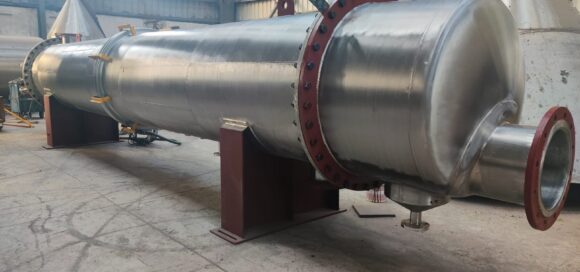
If your plant processes APIs, bulk drugs, solvents, or fine chemicals, a heat exchanger is not optional equipment — it is a critical process asset. Selecting the wrong unit, or the wrong supplier, directly affects product quality, solvent recovery efficiency, and regulatory compliance. This guide is written for plant engineers, purchase managers, and project consultants who need accurate technical and commercial information before making a sourcing decision.
Pragati Engineers, based in Ambala, Haryana, has manufactured industrial heat exchangers and condensers for pharmaceutical and chemical process plants since 1996. Every unit we supply is built to application-specific requirements and pressure-tested before dispatch.
What Is a Heat Exchanger?
A heat exchanger is a process device engineered to transfer thermal energy between two or more fluid streams without allowing them to physically mix. One stream is heated while the other is cooled. The efficiency of this exchange depends on the surface area available for heat transfer, the flow arrangement of the two fluids, the temperature differential between them, and the thermal conductivity of the construction material.
In industrial settings, heat exchangers serve three broad functions: heating a process fluid to trigger or sustain a reaction, cooling a product stream or reaction mass to safe handling temperatures, and condensing vapour — particularly solvent vapour — back into liquid form for recovery or safe disposal.
Why Heat Exchangers Are Critical in Pharmaceutical & Chemical Industries
The pharmaceutical and chemical industries impose requirements on heat exchangers that general industrial applications do not. Consider the following operational realities:
- API synthesis reactions are exothermic. Removing heat rapidly and predictably is a safety and yield requirement, not a convenience.
- Solvent recovery is directly tied to manufacturing economics. A heat exchanger that condenses solvent vapour incompletely wastes raw material and creates emission control problems.
- Product purity standards mean the heat exchanger’s internal surfaces must resist corrosion from aggressive solvents and acids, and must not shed particulates or ionic contamination into the process stream.
- Cleanability and drainability requirements mean dead legs and horizontal tube bundles that trap liquid may be unacceptable depending on the product.
For a broader understanding of how heat exchangers fit within a complete process train, refer to our detailed overview of pharmaceutical process equipment used in modern manufacturing plants.
Types of Heat Exchangers Used in Pharma and Chemical Plants
Shell and Tube Heat Exchanger
The shell and tube design is the most widely used configuration in pharmaceutical and chemical process plants across India. A bundle of tubes is enclosed within a cylindrical shell. One fluid flows through the tubes while the second fluid flows over the tube bundle within the shell, separated by baffles that direct the flow and improve contact. The design offers a large heat transfer surface area in a compact footprint and is straightforward to clean and maintain when a removable tube bundle is specified.
Pragati Engineers manufactures shell and tube heat exchangers in both single-pass and multi-pass configurations, with tube materials in SS 304 or SS 316 and shell fabrication in mild steel or stainless steel. Heat transfer area is customisable from 0.5 m² up to 50 m² depending on process duty. Units are available in vertical or horizontal mounting orientation. All units are hydraulically tested up to 10 Bar before despatch.
U-Tube Heat Exchanger
A U-tube exchanger uses tubes bent into a U-shape. The tube bundle can be removed as a single assembly for cleaning, which is an advantage in pharmaceutical applications where periodic inspection is required. The design accommodates thermal expansion without requiring expansion joints in the shell, making it suitable for high-temperature differential duties.
Straight Tube (Fixed Tube Sheet) Heat Exchanger
In this configuration, tubes are fixed at both ends to tube sheets that are welded to the shell. This is a cost-effective design for moderate duties where tube-side cleaning is not a frequent requirement, or where cleaning can be done chemically in-place (CIP).
| Feature | Shell & Tube (Multi-Pass) | U-Tube | Straight Tube (Fixed Sheet) |
| Heat Transfer Efficiency | High | Moderate–High | Moderate |
| Ease of Mechanical Cleaning | Moderate (with removable bundle option) | High (removable bundle) | Shell-side only |
| Thermal Expansion Handling | Requires expansion joints or floating head | Inherent — no joints needed | Limited — suited to low differentials |
| Typical Pharma Application | Solvent condensation, reactor cooling | High-temp API processes | Utility water cooling, CIP loops |
| Fabrication Cost | Moderate | Moderate–High | Lower |
Materials of Construction for Pharmaceutical Heat Exchangers
Material selection is the most consequential engineering decision in heat exchanger procurement for pharmaceutical or chemical service. The wrong material leads to corrosion, product contamination, and unplanned shutdowns.
- SS 316 / SS 316L: Preferred for tube-side surfaces in contact with process fluids in pharmaceutical and API service. The addition of molybdenum provides superior resistance to chloride pitting and general corrosion from organic acids and solvents. SS 316L (low carbon) is specified where welded joints are present to prevent sensitisation.
- SS 304: Suitable for less aggressive services, cooling water circuits, and shell fabrication where the shell-side fluid is clean utility water or steam.
- Mild Steel (MS) Shell with SS Tubes: A common and cost-effective combination where shell-side utility fluid is non-corrosive and only the tube-side contacts the process stream.
For high-purity pharmaceutical processes or where chloride stress corrosion cracking is a risk, higher alloys such as Hastelloy may be evaluated — consistent with the material grades available in the broader range of API and bulk drug equipment we supply.
Common Applications: Where Heat Exchangers Are Used
- Solvent Recovery Systems: The condenser is the primary heat exchanger in any solvent recovery train. Vapour exiting a still or reactor is passed through the heat exchanger, where it is cooled below its dew point and condensed back to liquid. See our solvent recovery plant for the complete system.
- Reactor Cooling: Exothermic API synthesis reactions generate heat that must be removed continuously to prevent runaway reactions. A heat exchanger is connected to the reactor jacket circuit or the reflux condenser port to manage this duty. View our reactor range for integrated process solutions.
- Distillation Overhead Condensers: In fractional distillation for solvent purification, the overhead vapour is routed to a condenser where it is liquefied and either returned as reflux or collected as product.
- Product Cooling Before Transfer: Hot product streams exiting reactors or crystallisers are cooled to transfer temperature before being pumped to receivers or storage vessels.
- CIP Return Cooling: In formulation plants, CIP return water is often cooled through a heat exchanger before re-entering storage tanks.
Our chemical processing equipment range covers the broader equipment portfolio that heat exchangers are integrated with in chemical manufacturing plants.
How Heat Exchangers Work with Reactors and Solvent Recovery Plants
Understanding the process context is essential before specifying a heat exchanger. In a typical API batch synthesis plant, the reactor generates solvent vapour as the reaction proceeds. This vapour exits through a top-mounted nozzle and enters the heat exchanger acting as a condenser. Cooling water or chilled water circulates on the shell side. The vapour condenses on the tube surface and flows as liquid back into the reactor or forward into a collection receiver.
In a dedicated solvent recovery plant, a larger heat exchanger handles the continuous condensation load from the distillation column overhead. The recovered solvent is collected, tested for purity, and recycled back into production — directly reducing raw material cost and regulatory waste burden.
This integrated process view — reactor, heat exchanger, receiver, and solvent recovery system operating as a connected train — is why Pragati Engineers manufactures all four equipment types and supplies them as coordinated packages where required.
How to Choose the Right Heat Exchanger: Engineer’s Buying Checklist
Before approaching any heat exchanger supplier in India, your engineering team should have answers to the following questions. This checklist is the minimum information a competent manufacturer needs to size and quote correctly.
- What is the process fluid on the tube side, and what is its flow rate (kg/hr or m³/hr)?
- What is the inlet and required outlet temperature of the process fluid?
- What utility fluid (cooling water, chilled water, steam) is available on the shell side, and at what temperature and flow rate?
- What is the operating pressure on both tube side and shell side?
- Are there corrosive components — halides, acids, bases — that dictate material selection beyond standard SS 304?
- Is the heat exchanger handling liquid-to-liquid duty, vapour condensation, or liquid heating with steam?
- Is mechanical cleaning of the tube bundle required? If yes, a removable bundle or U-tube design should be specified.
- What mounting orientation (vertical or horizontal) does the plant layout permit?
- What documentation is required — material test certificates, hydraulic test certificate, datasheet, GA drawing?
Important Buying Factors When Sourcing from Heat Exchanger Suppliers in India
The Indian market for industrial heat exchangers ranges from general-purpose fabricators to specialised pharmaceutical equipment manufacturers. The distinction matters significantly for regulated industries.
- Pharmaceutical Process Experience: A supplier familiar with GMP environments understands material traceability, surface finish requirements, and documentation needs that a general fabricator may not prioritise.
- Custom Engineering Capability: Standard catalogue sizes rarely match the specific heat duty, nozzle locations, and space constraints of an existing plant. Confirm the supplier can engineer to your URS.
- Pressure Testing and Certification: Hydraulic testing to rated pressure should be standard. Ask for the test certificate as part of the supply documentation.
- Material Traceability: In pharmaceutical applications, material test certificates (MTCs) for SS tubes and plates should be available on request.
- Integration Capability: If the heat exchanger will be part of a solvent recovery system or connected to reactors, a supplier who also manufactures those systems can design for physical and process compatibility.
- After-Sales and Spare Parts: Tube bundle cleaning, re-rolling, and spare gasket supply are routine maintenance requirements. Confirm the supplier can support these needs.
For a wider reference on evaluating process equipment manufacturers, see our guide on how to choose the right pharmaceutical equipment manufacturer in India.
Questions to Ask Before Buying a Heat Exchanger
- Can you size the unit based on my process duty sheet, or do you only supply standard sizes?
- What design code or standard is used for fabrication?
- Is hydraulic testing included in the scope of supply, and will a test certificate be provided?
- What are the tube and shell material grades, and can MTCs be provided?
- Is a removable tube bundle available, and what is the cleaning access on the tube side?
- What is the lead time from order confirmation to dispatch?
- Do you manufacture the associated equipment — reactor, receiver, solvent recovery plant — so that nozzle schedules and interconnection piping can be standardised?
Why Proper Engineering Matters
An undersized heat exchanger on a solvent recovery system will result in incomplete condensation, solvent losses, emission violations, and poor batch-to-batch consistency. An oversized unit adds unnecessary capital cost and occupies space in an already constrained plant layout. Correct sizing requires a proper process calculation — not a catalogue guess.
Since 1996, Pragati Engineers has supplied heat exchangers and condensers to pharmaceutical, API, bulk drug, and chemical plants across India. Our manufacturing facility is located in the Industrial Estate, Ambala Cantt, Haryana — a region with a long history of precision engineering and scientific instrument manufacturing. We build to customer specifications and supply complete documentation packages to support your regulatory requirements.
For related reading on the full range of process equipment used in API and formulation plants, see our article on SS reactor manufacturers in India.
Get a Quote for Your Heat Exchanger Requirement
Share your process duty — fluid type, flow rate, temperatures, operating pressure, and material preference — and our engineering team will respond with a correctly sized unit and a detailed quotation. We manufacture shell and tube heat exchangers with heat transfer areas from 0.5 m² to 50 m², in SS 304 and SS 316, with single-pass and multi-pass configurations.
View the product: Condenser / Heat Exchanger — Pragati Engineers
Call us: (0171)-2699162
Email: pragati@pragatiengineers.com
Address: No. 87, Industrial Estate, Ambala Cantt, Ambala – 133 006, Haryana, India
Frequently Asked Questions
What is a heat exchanger used for in pharmaceutical manufacturing?
In pharmaceutical manufacturing, heat exchangers are used to cool or heat process fluids during reactions, condense solvent vapours during distillation, recover solvents in API production, and control temperature in jacketed reactors. They are essential for maintaining process safety, product purity, and energy efficiency.
What material is best for a pharmaceutical heat exchanger?
SS 304 and SS 316 are the most widely used materials. SS 316 offers superior corrosion resistance to chlorides and harsh chemicals and is preferred for API and bulk drug processes. The shell may be fabricated in mild steel or stainless steel depending on process requirements.
What is the difference between a single-pass and multi-pass heat exchanger?
In a single-pass design, the tube-side fluid passes through the shell once. In a multi-pass design, the fluid is directed back and forth multiple times, increasing contact time and improving thermal efficiency. Multi-pass designs are preferred when a high degree of heat transfer is required in a compact unit.
Can a heat exchanger be used with a reactor?
Yes. Heat exchangers are routinely integrated with reactors. They cool or condense vapour exiting the reactor’s reflux condenser port, recover solvents, and help maintain precise temperature control. Pragati Engineers manufactures both reactors and heat exchangers designed for seamless integration.
What heat transfer area range is available?
Pragati Engineers manufactures heat exchangers with a heat transfer area ranging from 0.5 m² to 50 m². Custom designs are available based on your process requirements and URS.
Are Pragati Engineers heat exchangers hydraulically tested?
Yes. All heat exchangers are hydraulically tested up to 10 Bar to ensure structural integrity and leak-free performance before dispatch.
How do I choose the right heat exchanger supplier in India?
Look for manufacturers with verifiable pharmaceutical industry experience, custom sizing capability, use of GMP-compatible materials such as SS 304 or SS 316, hydraulic pressure testing, proper documentation, and reliable after-sales support. Pragati Engineers has served pharma and chemical plants from Ambala since 1996.
What is the delivery time for a custom heat exchanger from Pragati Engineers?
Delivery time depends on the complexity and size of the order. Share your URS with our team at pragati@pragatiengineers.com or call (0171)-2699162 for a confirmed lead time and configuration