
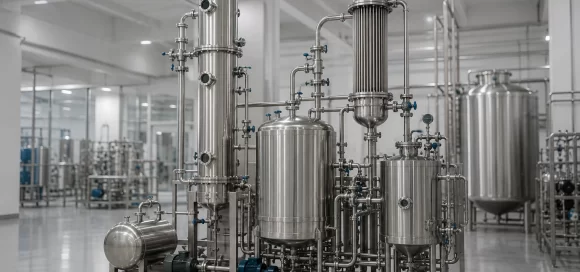
Solvent costs are one of the largest variable expenses in API and bulk drug manufacturing. In a typical multi-step synthesis plant, organic solvents account for a significant share of the raw material budget — and without an effective recovery system, a substantial portion of that spend is discarded with every batch. A properly designed solvent recovery plant does not simply reduce waste — it converts what would otherwise be a disposal liability into a reusable production input, directly improving the economics of each batch while supporting environmental compliance.
This guide is written for plant engineers, process engineers, purchase managers, and project consultants who are evaluating solvent recovery plant suppliers in India for pharmaceutical, API, bulk drug, herbal extraction, or chemical manufacturing plants.
Pragati Engineers, based in Ambala, Haryana, has manufactured solvent recovery systems for pharmaceutical and chemical process plants since 1996. Our Solvent Recovery Plant is available in SS 304, SS 316L, Hastelloy, and Nickel, with a standard production capacity of 20 KLD and tailor-made configurations designed to the customer’s URS. Sea-worthy export packaging is included as standard.
What Is a Solvent Recovery Plant?
A solvent recovery plant is an integrated process system that collects solvent-laden streams generated during pharmaceutical manufacturing — mother liquors from filtration, spent wash solvents, condensate from drying operations, and cleaning effluents — and processes them through distillation to separate and purify the solvent for reuse.
The core operating principle is fractional distillation. The contaminated solvent mixture is heated in a still pot or reboiler. Vapour rises into the distillation column, where repeated vapour-liquid contact on trays or structured packing achieves the separation of lower-boiling components from higher-boiling impurities. The overhead vapour — enriched in the target solvent — passes into the condenser, where it is cooled and liquefied. The condensate is collected in a receiver vessel, analysed for purity, and either returned to production as recovered solvent or subjected to further purification.
When people in the Indian pharmaceutical equipment industry refer to a distillation column manufacturer in India, they are typically referring to the separation column itself — the vertical packed or tray column that performs the actual separation. The solvent recovery plant is the complete system: still pot, column, condenser, receiver, reflux system, and instrumentation, all engineered as a single integrated unit. Pragati Engineers supplies both the complete plant and the individual column where required.
For a broader understanding of how solvent recovery fits within the complete API manufacturing equipment chain, see our guide on pharmaceutical process equipment used in modern manufacturing plants.
Why Solvent Recovery Is Critical in API and Pharmaceutical Manufacturing
The business and regulatory case for solvent recovery in pharmaceutical manufacturing is compelling across multiple dimensions:
- Direct raw material cost reduction: Organic solvents such as methanol, IPA, ethyl acetate, and toluene are significant recurring costs in API synthesis. Recovering and reusing 80–95% of the solvent consumed per batch directly reduces purchase volumes and improves batch contribution margins.
- Hazardous waste reduction: Pharmaceutical solvents are classified as hazardous waste under environmental regulations. Disposal costs, manifesting requirements, and regulatory scrutiny associated with large volumes of solvent waste are eliminated when the solvent is recovered and recycled rather than discarded.
- Regulatory compliance: Pollution control boards and environmental regulators in India increasingly require pharmaceutical manufacturers to demonstrate solvent recovery capability as a condition of consent to operate. A solvent recovery plant is no longer optional for most API manufacturing facilities.
- Reduced atmospheric emissions: Without recovery, solvent vapours from open process steps — filtration, drying, vessel cleaning — are exhausted to atmosphere. A closed-loop recovery system captures these vapours, reducing VOC (volatile organic compound) emissions and associated regulatory exposure.
- Process economics at scale: As batch sizes increase, the absolute volume of solvent lost without recovery grows proportionally. A solvent recovery plant that recovers even 85% of solvent consumption at commercial scale represents a multi-crore annual saving in raw material cost for a mid-sized API plant.
Key Components of a Solvent Recovery Plant
Understanding the individual components of a solvent recovery plant helps engineers write better specifications and evaluate supplier proposals more critically.
Still Pot / Reboiler
The still pot is the heating vessel at the base of the distillation system. It receives the contaminated solvent feed and provides the heat input — through a steam jacket or internal heating coil — that drives vaporisation. The still pot is designed as a jacketed pressure vessel with the appropriate material of construction for the solvent system being processed.
Distillation Column
The column is the separation heart of the system. Rising vapour and descending liquid are brought into repeated contact on structured packing, random packing, or distillation trays inside the column. Each stage of contact improves the separation between the target solvent and heavier impurities or higher-boiling co-solvents. Column height, diameter, and internals design are determined by the required separation efficiency and throughput.
Condenser / Heat Exchanger
The overhead vapour leaving the top of the column enters the condenser — a shell and tube heat exchanger with cooling water or chilled water on the shell side. The vapour condenses on the tube surfaces and flows as liquid to the reflux drum. Pragati Engineers manufactures the condenser and heat exchanger for solvent recovery applications in SS 304/SS 316, multi-pass shell and tube design, with heat transfer areas from 0.5 m² to 50 m² and hydraulic testing up to 10 Bar.
Reflux Drum and Reflux System
A portion of the condensed overhead liquid is returned to the top of the column as reflux — this returning liquid is essential to maintain the vapour-liquid contact that drives separation. The remaining condensate is drawn off as the recovered product. The reflux ratio — the ratio of returned liquid to product drawn off — is a key operating parameter that determines the purity of the recovered solvent and the throughput of the system.
Receiver Vessel
The recovered solvent is collected in a stainless steel receiver vessel before being transferred to storage or back into production. Sampling points on the receiver allow quality checks — typically gas chromatography for purity assay — before the solvent is approved for reuse. Pragati Engineers supplies receiver vessels as part of the complete solvent recovery system scope.
Vacuum System
For solvents with high boiling points or for processes requiring distillation at lower temperatures to prevent thermal degradation of residual product in the still pot, the system operates under vacuum. Reduced pressure lowers the effective boiling point, enabling distillation at safer temperatures and protecting heat-sensitive materials in the still pot residue.
Solvent Recovery Plant Specifications: Pragati Engineers
| Parameter | Specification |
|---|---|
| Production Capacity | 20 KLD (kilolitres per day) |
| Vessel Capacity | 100 L standard (available in different capacities) |
| Material of Construction | SS 304, SS 316L, Hastelloy, Nickel |
| Finishing | Mirror / Matt Finish |
| Automation Grade | Semi-Automatic |
| Power Supply | 415 V / 50 Hz |
| Customisation | Tailor-made as per URS |
| Delivery Time | Approximately 3 months |
| Packaging | Sea-worthy export packaging |
| Country of Origin | Made in India |
How a Solvent Recovery Plant Connects to the API Process Train
In a complete API batch manufacturing plant, solvent recovery is not a standalone system — it is the downstream processing hub that receives solvent-bearing streams from multiple upstream equipment items. Understanding these connections is essential for engineers designing or expanding an API facility.
The primary solvent sources feeding a recovery plant in a typical API plant are:
- Reactor mother liquors and wash solvents: After each reaction step in the SS reactor, the reaction mixture is filtered. The filtrate — the mother liquor — contains dissolved impurities and a large volume of process solvent. This stream is routed directly to the solvent recovery plant.
- ANFD filtrates: The Agitated Nutsche Filter Dryer (ANFD) generates filtrate from pressure filtration and wash solvents from successive cake washing stages. These solvent-rich streams are collected and fed to the recovery system.
- Drying condensate from VTD and RVPD: During vacuum drying in the Vacuum Tray Dryer or Rotary Vacuum Paddle Dryer, residual solvent evaporates from the product cake and is condensed in the dryer’s condenser unit. This recovered condensate is typically of high purity and can be directly returned to the recovery plant or fed back to production after quality check.
- Equipment cleaning solvents: Solvent-based cleaning of reactors, vessels, and pipework between batches generates significant volumes of dilute solvent that are economically worth recovering at commercial scale.
Pragati Engineers manufactures all of the upstream equipment in this process train — reactors, ANFDs, VTDs, RVPDs, and heat exchangers — alongside the complete solvent recovery system, enabling coordinated engineering of the full plant as an integrated system rather than a collection of individually sourced items. For the complete range of API plant equipment, see our API, Bulk Drugs, and Chemicals equipment category.
Material of Construction: Choosing Between SS 316L, Hastelloy, and Nickel
The solvent system being processed determines the correct material of construction for the still pot, column shell, condenser, and all wetted components of the recovery plant. Selecting the wrong material leads to corrosion, product contamination, and equipment failure.
| Material | Suitable Solvent Systems | Key Advantage | When to Specify |
|---|---|---|---|
| SS 304 | Ethanol, IPA, acetone, general organic solvents (non-chlorinated, non-acidic) | Cost-effective for low-corrosivity duties | Utility vessels, non-critical streams |
| SS 316L | Most pharmaceutical solvents including methanol, ethyl acetate, toluene, IPA, DMF (dilute) | Molybdenum content improves chloride and acid resistance; low carbon for weld integrity | Standard pharmaceutical and API solvent recovery |
| Hastelloy C-276 | Chlorinated solvents (DCM, chloroform), strong acid-bearing streams, oxidising media | Exceptional corrosion resistance across a wide range of aggressive chemical environments | Highly corrosive API solvents where SS 316L is insufficient |
| Nickel | Caustic (sodium hydroxide) bearing streams, high-purity chemical applications | Excellent resistance to caustic solutions at elevated temperatures | Specific caustic or high-purity chemical applications |
Engineer’s Buying Checklist: What to Specify Before Ordering a Solvent Recovery Plant
Before approaching solvent recovery plant suppliers in India, prepare a process data sheet with the following information. A competent supplier will need these inputs to size the system correctly and select appropriate materials and column internals.
- What solvent or solvent mixture is being recovered, and what are the approximate compositions of the feed stream?
- What is the required throughput — litres per hour or kilolitres per day of feed to the recovery system?
- What is the target purity of the recovered solvent, and what quality standard (GC purity %) must it meet for reuse in production?
- Are the solvents flammable — and if so, what area classification applies to the installation location? This determines whether ATEX-rated electrical components and flameproof motors are required.
- Are any chlorinated solvents, strong acids, or caustic solutions present in the feed stream? This determines material of construction beyond SS 316L.
- What utilities are available — steam at what pressure, cooling water or chilled water at what temperature, and vacuum source if required?
- Is atmospheric or vacuum operation required? High-boiling solvents and temperature-sensitive residues generally require vacuum distillation.
- What automation level is required — manual, semi-automatic, or fully automated with PLC control and HMI?
- What documentation is required — process flow diagram (PFD), piping and instrumentation diagram (P&ID), equipment datasheet, pressure vessel certification, material test certificates?
- Is the plant intended for export? If so, sea-worthy packaging and export documentation will be required.
How to Choose the Right Solvent Recovery Plant Supplier in India
India has a well-established industrial equipment manufacturing sector, and several companies offer solvent recovery plants. However, the capability to correctly engineer a pharmaceutical-grade solvent recovery system — with appropriate material selection, column design, condenser sizing, and regulatory documentation — is not uniformly distributed across all fabricators. When evaluating suppliers, prioritise the following:
- Pharmaceutical process experience: Solvent recovery in a regulated pharmaceutical environment involves quality requirements — recovered solvent purity documentation, GMP-compatible construction, and audit trail capability — that general chemical plant fabricators are not always equipped to meet.
- Custom engineering capability: No two API plants have identical solvent profiles, throughput requirements, or utility configurations. A supplier who engineers to your URS rather than quoting a standard catalogue system is more likely to deliver equipment that performs correctly from commissioning.
- Complete system scope: Confirm whether the supplier provides the complete system — still pot, column, condenser, receiver, reflux system, instrumentation, and interconnecting pipework — or only the column and major vessels. Sourcing the condenser, receiver, and instrumentation separately adds coordination risk.
- Integration with upstream equipment: A supplier who also manufactures the reactors, ANFDs, and drying equipment connected to the solvent recovery system can design the complete plant as an integrated system, with standardised nozzle schedules and interconnection piping.
- Export capability: If the plant is intended for export, confirm the supplier has experience with sea-worthy packaging, export documentation, and international project execution.
Pragati Engineers has manufactured solvent recovery plants and the associated process equipment for pharmaceutical, API, and chemical plants from Ambala since 1996. We supply complete systems engineered to the customer’s URS, in SS 304, SS 316L, Hastelloy, and Nickel, with sea-worthy export packaging as standard.
Get a Quote for Your Solvent Recovery Plant
Share your process requirements — solvent type and composition, required throughput, target recovery purity, available utilities, automation level, and any special material or documentation requirements — and our engineering team will respond with a system correctly sized and configured for your plant. Custom capacities, special alloy MOCs, full process documentation, and sea-worthy export packaging are all available.
View the product: Solvent Recovery Plant — Pragati Engineers
Call us: +91-9896008557 / +91-7496970799
Email: pragati@pragatiengineers.com
Address: No. 87, Industrial Estate, Ambala Cantt, Ambala – 133 006, Haryana, India
Frequently Asked Questions
What is a solvent recovery plant and why is it used in pharmaceutical manufacturing?
A solvent recovery plant collects, distils, and purifies solvents used in pharmaceutical synthesis, extraction, and cleaning so they can be reused in production. In API manufacturing, large volumes of organic solvents are consumed in every batch. A recovery system converts what would otherwise be a disposal liability into a reusable production input, reducing raw material cost, minimising hazardous waste, and supporting environmental compliance.
What solvents can be recovered using the Pragati Engineers system?
Pragati Engineers designs each solvent recovery plant as a tailor-made system based on the customer’s URS. The system can be configured for methanol, ethanol, IPA, acetone, ethyl acetate, toluene, DCM, hexane, and other organic solvents — subject to process-specific engineering for each solvent’s boiling point, corrosivity, and flammability characteristics.
What is the production capacity of the Pragati Engineers solvent recovery plant?
The standard configuration has a production capacity of 20 KLD (kilolitres per day). Custom capacities are available based on your process throughput and URS.
What materials of construction are available?
Pragati Engineers supplies solvent recovery plants in SS 304, SS 316L, Hastelloy, and Nickel. SS 316L is the standard choice for most pharmaceutical solvent recovery duties. Hastelloy is specified for highly corrosive systems, including chlorinated solvents and acid-bearing streams.
What is the difference between a solvent recovery plant and a distillation column?
A distillation column is a single separation vessel — the vertical packed or tray column where vapour-liquid contact separates components. A solvent recovery plant is the complete integrated system: still pot, column, condenser, reflux drum, receiver, instrumentation, and interconnecting pipework. When evaluating distillation column manufacturers in India, confirm whether the supplier offers the complete system or only the column itself.
Does the solvent recovery plant include the condenser and heat exchanger?
Yes. The condenser/heat exchanger is a core component of the complete solvent recovery system. Pragati Engineers manufactures both the complete solvent recovery plant and the individual shell and tube condenser units used within it, in SS 304/SS 316 with heat transfer areas from 0.5 m² to 50 m².
Is sea-worthy export packaging available?
Yes. Pragati Engineers includes sea-worthy export packaging as standard with solvent recovery plant orders, making the equipment suitable for international project delivery. Delivery time is approximately 3 months from order confirmation, subject to URS complexity.
How do I choose the right solvent recovery plant supplier in India?
Prioritise suppliers with pharmaceutical process experience, custom URS-based engineering capability, appropriate MOC options including Hastelloy for corrosive solvents, complete system scope (not just the column), and the ability to integrate the recovery system with upstream reactors, ANFDs, and dryers from the same manufacturer. Pragati Engineers has supplied complete solvent recovery systems to pharmaceutical and API plants from Ambala since 1996.