
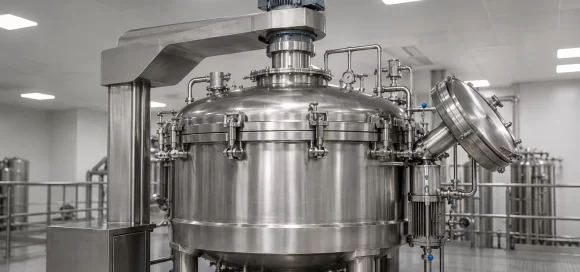
For plant engineers and purchase managers sourcing filtration equipment for API synthesis, bulk drug manufacturing, or fine chemical production, the Agitated Nutsche Filter Dryer is one of the most technically demanding items on the equipment list. Specifying it incorrectly — in terms of material of construction, agitator design, pressure rating, or sealing system — can create regulatory compliance problems, product contamination risks, or chronic operational failures. This guide covers everything a process engineer or equipment buyer needs to know before approaching ANFD manufacturers in India.
Pragati Engineers, based in Ambala, Haryana, has manufactured closed-system filtration and drying equipment for pharmaceutical, API, and chemical process plants since 1996. Our Agitated Nutsche Filter Dryer is built in SS316L, rated to 3 Bar design pressure, available in capacities up to 5000 litres, and engineered to GMP and cGMP requirements.
What Is an Agitated Nutsche Filter Dryer (ANFD)?
An Agitated Nutsche Filter Dryer — universally abbreviated to ANFD in the pharmaceutical and chemical industries — is a closed-system, multi-function process vessel that performs solid-liquid separation (filtration), cake washing, reslurrying, and vacuum drying within a single contained unit. In a conventional API manufacturing plant, these four operations would require four separate equipment items and three open product transfers between them. The ANFD eliminates all of those transfers and performs the entire sequence in a single sealed vessel.
The vessel is a vertical, cylindrical pressure- and vacuum-rated shell fitted with a filter plate at the bottom, a heating and cooling jacket on the shell, and a top-drive agitator that enters through a sealed gland at the top. The agitator performs multiple roles: it smooths the filter cake during filtration to prevent cracking and channelling, agitates the cake during washing to ensure uniform solvent contact, reslurries the cake when required, and then agitates and exposes fresh product surface during the final vacuum drying phase.
The closed design — with no open ports during operation — is what makes the ANFD the equipment of choice for handling toxic, potent, sterile, or highly valuable APIs and intermediates. For an overview of how the ANFD fits into the complete API manufacturing equipment chain, refer to our guide on pharmaceutical process equipment used in modern manufacturing plants.
ANFD vs ANPD: Understanding the Difference
Purchase managers and engineers sourcing filtration equipment in India frequently encounter both the terms ANFD and ANPD (Agitated Nutsche Pressure Dryer) in supplier catalogues and tender documents. The distinction is important to understand before writing a specification.
An ANFD combines filtration and drying in one vessel. The same vessel that receives the slurry from the reactor, separates the solid cake from the mother liquor under pressure, and washes the cake also performs vacuum drying of the cake without any product transfer. An ANPD is a related term used to describe pressure-rated nutsche dryer configurations where the primary function emphasis is on pressure drying rather than filtration — though in commercial practice in the Indian pharma market, the two terms are often used interchangeably for the same class of equipment.
The critical specification points that distinguish a correctly specified unit from an inadequately specified one are the design pressure rating, the agitator seal type and containment class, the filter plate design and medium, and the heating and cooling capability of the jacket — not simply the name applied to the equipment.
How an ANFD Works: Step-by-Step Process
Understanding the operational sequence of the ANFD helps engineers specify the correct unit for their process and avoid operational surprises after installation.
- Step 1 — Slurry Charging: The reaction slurry from the reactor — containing the solid API or intermediate suspended in the mother liquor — is transferred into the ANFD vessel under nitrogen or inert gas pressure, or by gravity from an elevated reactor. The vessel is sealed before charging begins.
- Step 2 — Pressure Filtration: Pressure is applied to the vessel headspace, forcing the mother liquor through the filter plate at the bottom. The solid cake builds up on the filter plate. The filtrate is collected in a receiver below the filter plate.
- Step 3 — Cake Smoothing: The agitator rotates slowly at a controlled depth to smooth the top surface of the filter cake, preventing cracks that would allow wash solvent to channel through without contacting the full cake volume.
- Step 4 — Cake Washing: Fresh wash solvent is added to the vessel and distributed across the cake surface. Pressure is re-applied to force the wash solvent through the cake, displacing impurities and mother liquor trapped within the cake. Multiple wash stages can be performed sequentially.
- Step 5 — Reslurrying (if required): For products requiring intensive washing, the agitator is used to completely reslurry the cake in fresh solvent before re-filtering. This step improves washing efficiency significantly compared to displacement washing alone.
- Step 6 — Vacuum Drying: After the final wash filtration, the vessel is connected to a vacuum system. The heating jacket supplies heat to the vessel wall. The agitator continues to rotate, continuously exposing fresh cake surface to the heated wall and the vacuum, driving off residual solvent to meet the final LOD specification.
- Step 7 — Discharge: The dried product is discharged through a bottom discharge valve or side discharge port, directly into a closed container or conveying system.
ANFD Specifications: Pragati Engineers
The following specifications reflect the Agitated Nutsche Filter Dryer supplied by Pragati Engineers. All configurations are available in custom sizes and material grades based on the customer’s URS.
| Parameter | Specification |
|---|---|
| Capacity | Up to 5000 Litres (custom sizes available) |
| Material of Construction (Product Contact) | SS316L |
| Body Material | Stainless Steel |
| Design Pressure | 3 Bar |
| Filter Area | 1 m² |
| Drive Type | Top Drive |
| Automation Grade | Semi-Automatic |
| Special Alloy Options | Hastelloy (for highly corrosive applications) |
| Operations Performed | Filtration, Washing, Reslurrying, Vacuum Drying |
| Compliance | GMP / cGMP |
| Custom Configuration | Available as per URS |
Materials of Construction: Why SS316L and When to Specify Hastelloy
Material selection for an ANFD in pharmaceutical and API service is not interchangeable between SS304, SS316, and SS316L, and the distinction matters significantly for regulatory compliance and equipment longevity.
- SS316L: The “L” designation indicates a low-carbon variant of SS316. This is critical for ANFDs because the vessel is heavily welded — jacket attachment welds, nozzle welds, agitator gland housing welds — and in standard SS316, the carbon content at weld heat-affected zones can precipitate chromium carbides, reducing the local corrosion resistance. SS316L eliminates this sensitisation risk. It is the standard product-contact MOC for pharmaceutical and API ANFDs.
- Hastelloy C-276 or C-22: Required for processes involving strong oxidising acids (nitric, sulphuric in concentrated form), chloride-bearing systems at elevated temperatures, or highly corrosive agrochemical intermediates where SS316L would suffer unacceptable corrosion rates. Hastelloy adds significant cost and lead time and should only be specified where the corrosion assessment justifies it.
- Halar (ECTFE) or PFA Lining: For highly corrosive applications where metallic construction is not suitable, lining the internal surfaces with Halar or PFA provides chemical resistance while maintaining the structural integrity of the stainless steel body. This approach is also available for the related Pressure Nutsche Filter, which Pragati Engineers supplies in SS316, SS304, Halar lining, and PFA lining options.
Pharmaceutical Filtration Equipment: ANFD vs Pressure Nutsche Filter vs Sparkler Filter
Plant engineers sourcing pharmaceutical filtration equipment in India need to understand the correct application for each type of filtration unit before writing a specification. Using the wrong equipment type for a given duty results in poor filtration performance, excessive wash solvent consumption, or product losses that directly affect batch yield and profitability.
| Feature | ANFD | Pressure Nutsche Filter | Sparkler Filter |
|---|---|---|---|
| Primary Function | Filtration + Washing + Drying (single vessel) | Filtration + Washing + Cake Recovery | Clarification of mother liquors and filtrates |
| Feed Type | Slurry with crystalline or amorphous solid | Slurry with solid cake | Liquid with fine suspended solids or trace insolubles |
| Drying Capability | Yes — vacuum drying in same vessel | No — product transferred to separate dryer | No |
| Agitation | Yes — top-drive agitator for cake smoothing, washing, reslurrying, drying | Optional agitation models available | No agitation |
| MOC (Pragati Engineers) | SS316L / Hastelloy | SS316, SS304, Halar, PFA, PP/FRP | SS316 / SS304 |
| Capacity Range | Up to 5000L | 50–5000L | Process-specific |
| Best Application | Potent APIs, toxic intermediates, high-purity bulk drugs requiring combined filtration and drying | Where drying is performed in a separate VTD or RVPD, or where product is transferred wet | Final clarification before filling or solvent recovery |
| Product Transfer Steps | Zero between filtration and drying | One — filtered cake transferred to dryer | N/A — liquid clarification only |
How the ANFD Connects to the Rest of the API Process Train
In a complete API batch manufacturing plant, the ANFD sits between the reactor and the final drying and packaging steps. Understanding this connectivity is important for both engineering the equipment correctly and writing a complete scope of supply.
The reaction slurry is generated in the SS reactor — where the API synthesis reaction proceeds at controlled temperature and pressure — and then transferred to the ANFD for filtration and drying. The mother liquor collected below the filter plate is routed either to waste treatment or, more commonly in API plants, to the solvent recovery plant, where the solvent is distilled, purified, and returned to production. The condenser in the solvent recovery system also handles the solvent vapours generated during the ANFD’s vacuum drying phase.
The dried API cake discharged from the ANFD then goes to secondary drying if required — in a Vacuum Tray Dryer for tray-format drying or a Rotary Vacuum Paddle Dryer for agitated drying of pasty materials — before milling, blending, and packaging. Pragati Engineers manufactures all equipment in this process train and can supply coordinated packages where nozzle schedules and interconnection requirements are standardised across the full system.
For the complete range of equipment available for API and bulk drug plants, see our API, Bulk Drugs, and Chemicals equipment category.
Engineer’s Buying Checklist: What to Specify Before Ordering an ANFD
Before approaching ANFD manufacturers in India, document the following process and engineering parameters. A manufacturer who asks for these inputs — rather than quoting a standard catalogue unit — is one worth dealing with.
- What product will be processed — its chemical nature, toxicity classification, and whether it is an OEB (Occupational Exposure Band) classified potent compound?
- What is the batch size in litres of slurry feed to the ANFD?
- What solvents are present in the mother liquor and wash stages — their nature (polar/non-polar), flammability, and toxicity?
- What is the required final LOD (Loss on Drying) specification after the ANFD drying cycle?
- What is the operating pressure requirement for pressure filtration, and what vacuum level is available for the drying phase?
- What heating and cooling utilities are available — steam at what pressure, chilled water at what temperature — for jacket conditioning?
- Is the process flammable — does it require ATEX-rated electrical components on the agitator drive and instrumentation?
- What material of construction is required — SS316L standard, or Hastelloy for aggressive corrosive service?
- What discharge arrangement is required — bottom discharge valve, side discharge chute, or direct connection to a closed container?
- What documentation package is required — FAT protocol, IQ/OQ documentation, material test certificates, pressure vessel certification, GMP compliance declaration?
How to Choose the Right ANFD Manufacturer in India
India has a well-established pharmaceutical equipment manufacturing industry, and several suppliers offer ANFDs. However, the capability to supply a correctly engineered, GMP-compliant, pressure-rated ANFD for pharmaceutical API service is not universal across all fabricators. When evaluating ANFD manufacturers in India, prioritise the following:
- Pressure vessel fabrication experience: An ANFD is a pressure-rated vessel. The manufacturer must have the capability and — where applicable — the certification to fabricate pressure vessels to the relevant Indian or international codes.
- SS316L and Hastelloy fabrication: Confirm the manufacturer routinely works with these materials and has the welding procedures and welder qualifications appropriate for pharmaceutical-grade fabrication.
- Top-drive agitator design: The agitator seal is the most critical reliability and containment component in the ANFD. Confirm the seal type — mechanical seal, magnetic coupling, or stuffing box — and its suitability for the operating temperature, pressure, and solvent compatibility of your process.
- GMP documentation capability: FAT protocols, material traceability, surface finish documentation (Ra values), and pressure test certificates are standard requirements for pharmaceutical installations. Confirm these are available.
- Process integration experience: A manufacturer who also supplies the reactor, solvent recovery plant, VTD, and RVPD that connect to the ANFD can engineer the complete system as an integrated package rather than requiring the customer to coordinate multiple suppliers.
Pragati Engineers has manufactured pharmaceutical filtration and drying equipment from Ambala since 1996, supplying plants across India in pharmaceutical, API, bulk drug, chemical, and agrochemical sectors. Our ANFD range is designed to meet GMP and cGMP requirements with full documentation support.
Get a Quote for Your ANFD Requirement
Share your process details — product type, batch size, solvent system, required LOD, design pressure, material of construction, and documentation requirements — and our engineering team will respond with a correctly configured Agitated Nutsche Filter Dryer and a detailed quotation. Custom capacities, special alloy MOCs, and complete GMP documentation packages are available.
View the product: Agitated Nutsche Filter Dryer (ANFD) — Pragati Engineers
Call us: +91-9896008557 / +91-7496970799
Email: pragati@pragatiengineers.com
Address: No. 87, Industrial Estate, Ambala Cantt, Ambala – 133 006, Haryana, India
Frequently Asked Questions
What is an ANFD (Agitated Nutsche Filter Dryer) used for?
An ANFD is used in pharmaceutical, API, chemical, and agrochemical manufacturing to perform solid-liquid separation, cake washing, reslurrying, and vacuum drying — all within a single closed vessel. It eliminates multiple open product transfer steps between separate filtration and drying equipment, reducing contamination risk, solvent losses, and operator exposure to hazardous compounds.
What is the material of construction for a pharmaceutical ANFD?
Pragati Engineers manufactures ANFDs with SS316L as the standard product-contact material. SS316L’s low carbon content prevents sensitisation at weld joints, making it the correct choice for heavily welded pharmaceutical-grade pressure vessels. Hastelloy is available for highly corrosive process applications.
What is the capacity range of the Pragati Engineers ANFD?
Pragati Engineers supplies ANFDs with a capacity of up to 5000 litres. Custom sizes are available based on your batch size and URS.
What is the design pressure of the ANFD?
The ANFD from Pragati Engineers is designed for 3 Bar operating pressure. The vessel is rated for both pressure and vacuum operation — enabling pressure filtration and vacuum drying to be performed sequentially in the same unit without any product transfer.
What is the difference between an ANFD and an ANPD?
Both ANFD (Agitated Nutsche Filter Dryer) and ANPD (Agitated Nutsche Pressure Dryer) refer to closed-system equipment that combines pressure filtration, cake washing, and vacuum drying in a single vessel. In commercial practice in India, the terms are largely used interchangeably. The critical specification points are the design pressure rating, agitator seal type, material of construction, and heating/cooling capability — not the name applied to the equipment.
Is the Pragati Engineers ANFD suitable for handling potent or toxic APIs?
Yes. The closed top-drive design with sealed agitator gland ensures full containment throughout all operational phases — filtration, washing, reslurrying, and drying. No open product transfer occurs between these steps, making it suitable for OEB-classified potent compounds and toxic chemical intermediates.
What filtration equipment works alongside an ANFD in an API plant?
An ANFD is typically used alongside a Pressure Nutsche Filter for separate filtration duties, a Sparkler Filter for mother liquor clarification, and a Solvent Recovery Plant to process the recovered filtrates and vapours. Pragati Engineers manufactures all of these equipment types.
How do I choose the right ANFD manufacturer in India?
Prioritise manufacturers with GMP and cGMP experience, SS316L and Hastelloy fabrication capability, pressure vessel certification, a well-engineered top-drive agitator seal system, and the ability to supply full documentation — FAT protocols, MTCs, and IQ/OQ support. Pragati Engineers has supplied ANFDs to pharmaceutical and API plants across India from Ambala since 1996.