
Selecting the right drying equipment is one of the most consequential decisions in pharmaceutical and chemical process plant engineering. The wrong dryer — whether in terms of operating principle, material of construction, or drying temperature — can degrade active ingredients, cause cross-contamination, or result in non-compliant moisture levels that fail batch release. This guide is written for plant engineers, process engineers, purchase managers, and project consultants evaluating Vacuum Tray Dryer manufacturers in India for pharmaceutical, API, herbal, nutraceutical, or chemical manufacturing applications.
Pragati Engineers, based in Ambala, Haryana, has manufactured vacuum drying equipment for pharmaceutical and chemical process plants since 1996. Our Vacuum Tray Dryer is built to GMP standards, supplied complete with condenser and receiver units, and available in SS304 and SS316 in custom tray configurations.
What Is a Vacuum Tray Dryer?
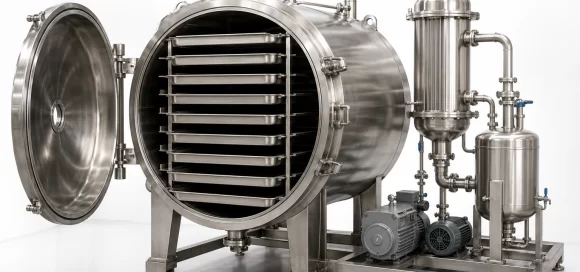
A Vacuum Tray Dryer (VTD) is a batch-type, indirect-heat drying system designed to remove moisture and solvents from heat-sensitive materials under reduced pressure. The operating principle is straightforward: by creating a vacuum inside a sealed chamber, the boiling point of water and organic solvents is significantly reduced. This allows the product to be dried at temperatures well below what conventional hot-air tray dryers require — protecting thermally labile active pharmaceutical ingredients, volatile aromatic compounds, and moisture-sensitive intermediates from degradation.
The product is spread in thin layers on stainless steel trays, which are placed on hollow heated shelves inside the chamber. Heat is transferred by conduction from the shelf surface to the tray and then to the product. The vapours generated are continuously removed by the vacuum system, pass through a condenser where they are liquefied, and the condensate is collected in a receiver vessel before the vacuum pump.
This makes the Vacuum Tray Dryer suitable not only for drying but also for partial solvent recovery — a feature of particular importance in API and chemical manufacturing where solvent losses represent a direct cost and a regulatory compliance burden. For a wider view of how drying equipment fits into a complete manufacturing process, refer to our overview of pharmaceutical process equipment used in modern manufacturing plants.
Why Pharmaceutical Plants Choose Vacuum Drying Over Conventional Drying
Hot-air tray dryers operate at atmospheric pressure, which requires higher temperatures to achieve the drying rates needed for commercial production. For many pharmaceutical products — particularly APIs synthesised through multi-step chemical reactions, herbal extracts, nutraceutical formulations, and enzyme-based products — these elevated temperatures cause measurable degradation of the active compound, discolouration, or loss of biological activity.
Vacuum drying addresses this directly:
- Lower drying temperature: Under vacuum, moisture evaporates at significantly lower temperatures. Products that would degrade above 60°C in a conventional dryer can be dried safely at 40–50°C in a vacuum dryer.
- Faster moisture removal: The reduced partial pressure of water vapour in the vacuum chamber accelerates the driving force for evaporation, often reducing drying time despite the lower temperature.
- Closed-system processing: The sealed chamber prevents oxygen ingress during drying — critical for oxidation-sensitive APIs and sterile intermediates.
- Solvent recovery: Organic solvents evaporated during drying are condensed and recovered rather than exhausted to atmosphere — reducing raw material cost and environmental emissions.
- Product integrity: Colour, aroma, texture, and active ingredient concentration are preserved, which is especially important in herbal extraction, nutraceutical, and food processing applications.
Vacuum Tray Dryer: Specifications at Pragati Engineers
The following specifications reflect the standard configuration of the Vacuum Tray Dryer supplied by Pragati Engineers. Custom configurations are available based on your URS (User Requirement Specification).
| Parameter | Specification |
|---|---|
| Number of Trays | 48 Trays |
| Tray Size | 32 × 16 inch |
| Number of Shelves | 8 |
| Material of Construction | SS304 / SS316 |
| Heating Medium | Steam |
| Maximum Operating Temperature | 150°C |
| Included Accessories | Condenser and Receiver Unit |
| Optional Additions | Vacuum Pump, Instrumentation, Control Systems |
| Custom Sizes | Available as per URS |
| Compliance | GMP Standards |
Types of Pharmaceutical Vacuum Dryers: VTD vs RVPD vs RCVD
Plant engineers frequently need to choose between three types of vacuum dryers. The right selection depends on the physical form of the feed material, the required agitation intensity, and whether solvent recovery is a priority. The table below compares the three configurations available from Pragati Engineers.
| Feature | Vacuum Tray Dryer (VTD) | Rotary Vacuum Paddle Dryer (RVPD) | Rotary Cone Vacuum Dryer (RCVD) |
|---|---|---|---|
| Operating Principle | Static batch — material on trays, heated shelves | Agitated batch — rotating paddle agitator in jacketed shell | Tumbling batch — slowly rotating conical vessel |
| Feed Material | Granules, powders, slabs, fragile products | Wet filter cakes, slurries, pastes, sticky materials | Powders, granules, crystals, free-flowing solids |
| Product Contact MOC | SS304 / SS316 | SS316 | SS316L |
| Heating Medium | Steam | Thermic Fluid / Steam / Hot Water | Steam |
| Max Operating Temp | 150°C | 150°C | Not specified — per URS |
| Product Agitation | None — static drying | Continuous — anchor paddle rotation | Gentle — vessel rotation |
| Best Suited For | Pharma, herbal, nutraceutical, food, research | API, chemical, agrochemical, fine chemicals | Pharma, chemical, food, agrochemical |
| Solvent Recovery | Yes — via condenser and receiver | Yes — via condenser and receiver | Yes — via condenser and receiver |
For wet powders, filter cakes, and slurries from an API synthesis step, the Rotary Vacuum Paddle Dryer (RVPD) — with its 1000L gross capacity, SS316 MOC, anchor paddle design, and 7.5HP motor — is generally the better fit. For powders and crystals requiring gentle tumbling with minimal product breakage, the Rotary Cone Vacuum Dryer (RCVD) — available in 1000L with SS316L product-contact material — should be evaluated.
Common Applications of Vacuum Tray Dryers in India
- API and Bulk Drug Manufacturing: Drying of synthesised active pharmaceutical ingredients after the final washing step. The closed-system, solvent-recovery capability makes the VTD a standard item in API and bulk drug plant equipment.
- Granulation Drying in Formulation Plants: After wet granulation, the moist granule mass requires drying to the correct loss-on-drying (LOD) specification before tablet or capsule compression. VTDs are widely used in powder processing and granulation lines for this step.
- Herbal Extraction: Concentrated herbal extracts and spray-dried powders contain thermally sensitive phytochemicals that degrade at conventional drying temperatures. Vacuum drying preserves these compounds effectively.
- Nutraceutical and Food Processing: Vitamins, probiotic powders, enzyme preparations, and speciality food ingredients all benefit from low-temperature vacuum drying to maintain potency and shelf life.
- Chemical Intermediates and Fine Chemicals: Many organic intermediates in agrochemical, dye, and fine chemical synthesis are temperature-sensitive or contain residual solvents that must be recovered rather than evaporated to atmosphere.
- Research and Development Laboratories: Small-scale VTDs are used in R&D and pilot plant settings for process development and stability studies before scale-up.
How a Vacuum Tray Dryer Fits Into the API Production Process
In a typical API batch manufacturing plant, the drying step follows filtration. The wet API cake — obtained from a centrifuge or a pressure nutsche filter or ANFD — is transferred to the VTD trays and loaded into the dryer. The chamber is sealed, vacuum is applied, and the heating shelves bring the product to the required drying temperature. Moisture and residual solvents evaporate, are condensed in the condenser unit, collected in the receiver, and either returned to solvent storage or processed through the solvent recovery plant for reuse.
This sequential connection — filtration, drying, solvent recovery — is a core process train in API manufacturing, and Pragati Engineers manufactures equipment for each stage of it.
Engineer’s Buying Checklist: What to Specify Before Ordering a VTD
Before approaching a Vacuum Tray Dryer manufacturer in India, your engineering team should have the following information documented. A competent manufacturer will need these inputs to correctly size and configure the equipment.
- What product will be dried — its physical form (granule, powder, slab, paste), approximate bulk density, and any known temperature sensitivity?
- What is the batch size in kilograms or litres of wet feed? This determines the number of trays and shelves required.
- What is the initial moisture or solvent content, and what is the required final LOD (Loss on Drying) specification?
- What solvents are present? Are they flammable, toxic, or chlorinated? This determines the vacuum system specification and whether flameproof electrical components are required.
- Is solvent recovery required, and if so, what purity of recovered solvent is acceptable?
- What is the available heating utility — steam at what pressure, thermic fluid at what temperature, or hot water?
- What material of construction is required — SS304 or SS316 — and does the process require electropolished product-contact surfaces?
- What documentation is required for regulatory purposes — FAT (Factory Acceptance Test), IQ/OQ protocols, material test certificates, GMP compliance declaration?
- Are there any space or layout constraints that affect the chamber orientation, door location, or connection nozzle positions?
How to Choose the Right Vacuum Tray Dryer Manufacturer in India
India has a large number of equipment fabricators who supply drying equipment, but not all of them have the pharmaceutical process experience, GMP manufacturing discipline, and documentation capability required for regulated applications. When evaluating a Vacuum Tray Dryer manufacturer in India, consider the following:
- Pharmaceutical-specific experience: A manufacturer who has supplied VTDs to regulated pharmaceutical plants understands the documentation, traceability, and testing requirements that a general fabricator may not.
- Custom engineering capability: Standard sizes rarely match every application. Confirm the manufacturer can engineer to your specific tray count, chamber dimensions, nozzle schedule, and URS.
- Complete system supply: The dryer alone is not a complete system. Confirm whether the condenser, receiver, vacuum pump, instrumentation, and control panel are included in the scope of supply or need to be sourced separately.
- Material traceability: For pharmaceutical applications, material test certificates (MTCs) for SS tubes, plates, and other raw materials should be available and provided with the equipment.
- Integration experience: If the VTD will be connected to a filtration system, solvent recovery plant, or dust extraction system, a manufacturer who supplies all of these can ensure physical and process compatibility.
- After-sales support: Tray replacement, door seal maintenance, and vacuum system servicing are routine requirements. Confirm that the manufacturer can supply spares and technical support.
Pragati Engineers has supplied pharmaceutical drying equipment from Ambala since 1996. We manufacture Vacuum Tray Dryers alongside the filtration, reaction, and solvent recovery equipment that connects to them in the process train — ensuring that the complete package is engineered as a system rather than as a collection of independently sourced items.
Get a Quote for Your Vacuum Tray Dryer Requirement
Share your process details — product type, batch size, moisture content, solvent type, required LOD, available heating utility, and material of construction preference — and our engineering team will respond with a correctly configured unit and a detailed quotation. Custom tray counts, chamber sizes, and documentation packages are available to meet your URS and regulatory requirements.
View the product: Vacuum Tray Dryer — Pragati Engineers
Call us: +91-9896008557 / +91-7496970799
Email: pragati@pragatiengineers.com
Address: No. 87, Industrial Estate, Ambala Cantt, Ambala – 133 006, Haryana, India
Frequently Asked Questions
What is a Vacuum Tray Dryer (VTD) used for in pharmaceutical manufacturing?
A Vacuum Tray Dryer is used to dry heat-sensitive materials — APIs, herbal extracts, granules, powders, and chemical intermediates — under vacuum conditions. Reduced pressure lowers the boiling point of moisture and solvents, enabling gentle drying at lower temperatures while preserving product quality, colour, aroma, and active ingredient concentration.
What is the material of construction for a pharmaceutical VTD?
Pharmaceutical-grade VTDs are manufactured in SS304 or SS316 stainless steel. SS316 is preferred for product-contact surfaces in API and bulk drug applications due to its superior resistance to corrosive solvents and chemicals. Pragati Engineers supplies both grades as per the customer’s process requirement.
What is the maximum operating temperature of the Pragati Engineers VTD?
The Vacuum Tray Dryer from Pragati Engineers has a maximum operating temperature of 150°C, using steam as the heating medium applied through hollow shelves to ensure uniform heat distribution across all 48 trays.
Why is a condenser and receiver unit included with the VTD?
During vacuum drying, moisture and solvents evaporate and must be efficiently removed from the system. The condenser liquefies these vapours, and the receiver collects the condensate before it can reach the vacuum pump. This protects the vacuum system, improves drying efficiency, and enables solvent recovery — which is critical in API and chemical manufacturing applications.
How does a VTD differ from a Rotary Vacuum Paddle Dryer?
A VTD is a static dryer — material sits on trays without agitation, ideal for fragile granules or slab materials. A Rotary Vacuum Paddle Dryer (RVPD) uses a rotating anchor paddle to continuously mix the material during drying, making it suitable for wet filter cakes, slurries, and pasty materials from API filtration steps. The right choice depends on the physical form and fragility of the product being dried.
What tray configuration does Pragati Engineers offer?
The standard configuration is 48 trays (32×16 inch each) across 8 shelves. Custom tray counts and chamber sizes are available based on the customer’s batch size and URS.
Is a VTD suitable for herbal and nutraceutical products?
Yes. The VTD is widely used in herbal extraction and nutraceutical manufacturing. Its ability to dry at low temperatures under vacuum preserves volatile active compounds, colour, and aroma that would be degraded by conventional hot-air drying.
How do I choose between a VTD, RVPD, and RCVD?
Choose a VTD for fragile granules, slabs, or materials that must not be agitated. Choose an RVPD for wet filter cakes, slurries, and pasty materials from filtration. Choose a Rotary Cone Vacuum Dryer (RCVD) when you need drying, mixing, and solvent recovery in a single closed vessel with gentle tumbling — ideal for free-flowing powders and crystals. Share your process URS with Pragati Engineers for a specific recommendation.