
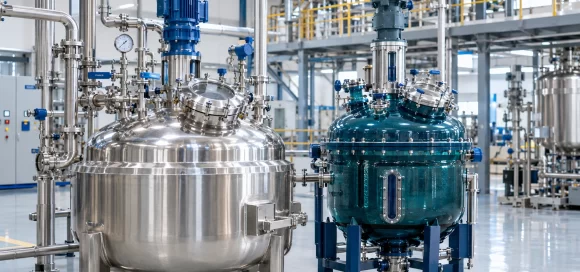
Choosing the wrong reactor material is one of the most expensive mistakes in a chemical or API plant. A reactor that corrodes in a few months can contaminate your batch, shut down production and cost far more than the saving you made at purchase. The three most common choices in India are stainless steel (SS), Hastelloy and glass-lined reactors. This guide explains how each one performs and how to decide.
Quick answer: Choose an SS 316L reactor for most general pharma and chemical reactions. Choose a Hastelloy reactor for hot, strong acids or chloride-rich media that attack stainless steel. Choose a glass-lined reactor for a wide range of acids when you do not need rapid heat transfer and can protect the glass from impact and thermal shock.
SS Reactor (SS 304 / SS 316L)
Stainless steel is the default material for reactors in pharma, API and fine chemical plants. SS 304 is used for non-critical, mild duties, while SS 316L contains molybdenum and resists corrosion better, which is why it is preferred for product-contact parts.
Where it works well
- Neutral, mildly acidic or alkaline reactions
- Solvent-based processes
- Processes needing good heat transfer and quick heating or cooling
- Pressure and vacuum duties
Where it fails
- Hot hydrochloric acid and other strong chloride solutions, which cause pitting and stress corrosion cracking
- Strongly acidic reactions at high temperature
Stainless steel is also the easiest to fabricate, repair, clean and polish. If your process allows it, SS is almost always the most economical choice. Read more about SS reactor manufacturers in India, or go directly to the SS reactor and stainless steel chemical reactor pages.
Hastelloy Reactor
Hastelloy is a family of nickel-based alloys, with Hastelloy C-276 being the grade most often used in chemical reactors. It resists a very wide range of corrosive chemicals, including many that attack stainless steel quickly.
Where it works well
- Hot hydrochloric, sulphuric and other aggressive acids (confirm the exact concentration and temperature with the alloy supplier)
- Chloride-rich media and halogenated solvents
- Processes where metal contamination from corrosion would damage the product
Points to consider
- Cost is much higher than stainless steel, so many buyers use a Hastelloy-clad or lined vessel instead of a fully solid Hastelloy one
- Welding and fabrication need skilled workmanship and the right procedure
- Heat transfer is lower than stainless steel but still better than glass
If you are looking for Hastelloy reactor suppliers in India, ask about the grade, whether the vessel is solid or clad, the weld procedure and the test reports. You can send us your process details for a Hastelloy reactor enquiry.
Glass-Lined Reactor
A glass-lined reactor is a carbon steel vessel with a layer of glass fused onto the inside surface. The glass resists most acids, including hot strong acids, and gives a very smooth, non-reactive surface.
Where it works well
- A wide range of acidic reactions, including chloride-containing acids
- Processes where metal ion contamination must be avoided
Where it fails
- Hydrofluoric acid and strongly alkaline media at high temperature
- Sudden temperature changes (thermal shock), which can crack the glass
- Mechanical impact, for example from tools or solids
Heat transfer in glass-lined vessels is slower, so heating and cooling cycles are longer. Damaged glass is repaired with patches, but a badly damaged lining often means relining the vessel.
SS vs Hastelloy vs Glass-Lined: Comparison
| Factor | SS 316L | Hastelloy | Glass-lined |
|---|---|---|---|
| Acid resistance | Limited, weak with hot chlorides | Very good across a wide range | Very good, except HF |
| Alkali resistance | Good | Good | Weak at high temperature |
| Heat transfer | Good | Moderate | Lower |
| Impact and shock tolerance | High | High | Low |
| Initial cost | Lowest | Highest | Medium |
| Repair | Easy | Needs skilled welding | Patching or relining |
| Typical use | General pharma and chemical | Aggressive acid and chloride duties | Acid reactions without thermal shock |
How to Choose the Right Reactor Material
- List every chemical in the batch, including reactants, solvents, catalysts and cleaning agents.
- Note concentration and temperature for each step, because corrosion rises quickly with heat.
- Check for chlorides and acids, the main reason SS reactors fail.
- Check heat transfer needs: fast heating or cooling points to metal, not glass.
- Consider contamination limits: if metal ions are a problem, glass-lined or clad vessels may be needed.
- Compare lifetime cost, not just the purchase price.
- Ask for corrosion data or a coupon test when the chemistry is new or aggressive.
If you are unsure, start with the process data and ask the supplier for a written material recommendation. A reputable manufacturer will tell you when SS is enough instead of selling a more expensive alloy.
Other Design Points for Any Reactor
- Jacket type: a plain, half-coil or dimple jacket affects heat transfer and pressure rating.
- Agitator and seal: the design must suit viscosity, solids and the sealing needs of the process.
- Condenser and receiver: a reactor usually works with a heat exchanger for reflux and condensation.
- Downstream equipment: filtration and drying in an ANFD and solvent handling in a solvent recovery plant.
- Surface finish and cleanability for GMP compliance.
Pragati Engineers also makes SS jacketed tanks for heating and cooling duties. For a full plant line, see our API equipment page.
Frequently Asked Questions
Which reactor material is best for pharma?
SS 316L is the most common choice for pharma and API reactors because it combines good corrosion resistance, easy cleaning and good heat transfer.
When should I use a Hastelloy reactor?
Use Hastelloy when your process involves hot strong acids or chloride-rich media that attack stainless steel.
Is a glass-lined reactor better than SS?
It is better for many acid reactions, but it has slower heat transfer and can crack from thermal shock or impact, so it is not better for every process.
Why does stainless steel corrode with chlorides?
Chloride ions can break the protective layer on stainless steel, causing pitting and stress corrosion cracking, especially when hot.
Can a Hastelloy reactor be clad instead of solid?
Yes. A clad or lined design uses Hastelloy only on the process side, which lowers cost while giving the same corrosion resistance at the surface.
How do I get a quote for a reactor?
Send your process details, batch volume and chemicals through our contact page.
Need Help Choosing a Reactor?
Share your chemicals, temperature and batch size, and our team will suggest the right material and design. See our SS reactor or get a quote.