
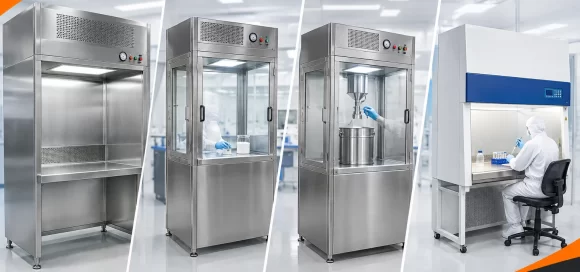
Pharma and biotech plants use several kinds of clean air equipment, and the names confuse many buyers: laminar air flow (LAF), reverse laminar air flow (RLAF) and biosafety cabinet (BSC). They all use HEPA-filtered air, but they protect different things. Choosing the wrong one can leave your operators, your product or your room exposed. This guide explains the difference in simple terms and helps you pick the right unit.
Quick answer: A laminar air flow unit mainly protects the product from contamination. A reverse laminar air flow unit (also called a sampling or dispensing booth) is used for powders and protects the operator from dust while keeping the work zone clean. A biosafety cabinet protects the operator, the product and the environment when working with biological material.
What Is Laminar Air Flow (LAF)?
A laminar air flow unit pushes air through a HEPA filter in smooth, parallel streams over the work area. The clean air flows either vertically (from the top down) or horizontally (from the back toward the operator). The aim is to keep the work zone free of particles, so it is used for product protection.
Typical uses are sterile preparation, media filling, testing of clean items and small assembly work. Because air moves toward the operator in a horizontal unit, it is not suitable for hazardous powders, toxic chemicals or infectious material.
What Is Reverse Laminar Air Flow (RLAF)?
A reverse laminar air flow unit is built for activities that create dust, such as sampling, weighing and dispensing of powders and raw materials in pharmaceutical manufacturing. Clean, HEPA-filtered air flows over the work zone, and the air together with any dust is drawn away from the operator through return grills and pre-filters, then filtered again. The result is a clean working area with the dust kept away from the person doing the work.
That is why RLAF is the usual choice for API and formulation plants where powders are handled. You may also see these units listed as reverse laminar air flow units, sampling booths or dispensing booths. Pragati Engineers supplies RLAF units for these duties; if you are comparing RLAF manufacturers in India, check the design, filter grade and finish listed below.
What Is a Biosafety Cabinet?
A biosafety cabinet is a ventilated enclosure for working with biological material such as microorganisms, cell cultures and samples. Air entering the cabinet and air leaving it passes through HEPA filters, so it protects the operator, the sample and the surroundings.
Biosafety cabinets come in classes:
- Class I: protects the operator and the environment, but not the sample.
- Class II: protects the operator, the sample and the environment. This is the most common type in microbiology, biotech and QC laboratories.
- Class III: a fully enclosed, gas-tight cabinet with glove ports for the highest-risk agents.
Biosafety cabinets are chosen by the biological risk of the work and by the standard your lab follows, so confirm the class and test requirements with your biosafety officer before buying.
RLAF vs LAF vs Biosafety Cabinet: Comparison
| Feature | Laminar Air Flow (LAF) | Reverse Laminar Air Flow (RLAF) | Biosafety Cabinet (BSC) |
|---|---|---|---|
| Main protection | Product | Operator from dust, with a clean work zone | Operator, product and environment |
| Air path | Clean air flows over the work area, toward the operator in horizontal types | Air is drawn away from the operator through return grills | Air is drawn in at the front, and supply and exhaust air are HEPA-filtered |
| Typical use | Sterile preparation, clean assembly | Sampling, weighing and dispensing of powders | Microbiology, cell culture, biotech labs |
| Suitable for hazardous powders | No | Yes (for dust and powder control) | For biological hazards, not general chemical powders |
| Typical setting | Pharma labs, cleanrooms | API and formulation plants | QC, microbiology and research labs |
How to Choose the Right Unit
- Start with the hazard: is it dust, a chemical or a biological agent?
- Decide who needs protection: the product, the operator, the environment, or all three.
- Check the process: powder dispensing and sampling points to RLAF; microbiological work points to a BSC; clean preparation points to LAF.
- Check the cleanroom grade: match the unit to the room and ISO classification you need.
- Check the filters: HEPA (H13 or H14 grade is common), pre-filters and a way to test or replace them.
- Check the build: stainless steel construction (SS 304 or SS 316) with a smooth, cleanable finish.
- Check testing and documents: filter integrity tests, airflow and particle counts, and the paperwork for your validation.
What to Look for in a Supplier
- A design that matches your process and cleanroom layout
- Stainless steel build quality, with smooth welds and easy-to-clean surfaces
- Filter grade, airflow control and alarms that suit your standard
- Test reports and documentation for validation
- After-sales support for filters, fans and service
Pragati Engineers also manufactures other cleanroom and contamination control items; browse our clean room equipment range, which includes items such as the sterile garment cabinet. For a complete plant line, see our API equipment page.
Frequently Asked Questions
What is the difference between LAF and RLAF?
A LAF unit mainly protects the product, while an RLAF unit is designed for powder handling and draws dust away from the operator.
Where is reverse laminar air flow used?
RLAF is used in sampling, weighing and dispensing areas of pharmaceutical and API plants.
Is an RLAF the same as a biosafety cabinet?
No. An RLAF is for dust and powder control in manufacturing. A biosafety cabinet is for biological safety in laboratories.
Can I use a laminar air flow unit for biological work?
No. A horizontal LAF blows air toward the operator and does not protect against biological hazards. Use a suitable biosafety cabinet instead.
What filters are used in these units?
They use pre-filters and HEPA filters. HEPA grades such as H13 or H14 are common, but the grade should match your standard.
How do I get a quote for an RLAF unit?
Share your application, size and cleanroom grade through our contact page and we will send a technical offer.
Need an RLAF or Cleanroom Unit?
Tell us what you handle and where it will be installed. See our reverse laminar air flow unit or contact us for a quote.