
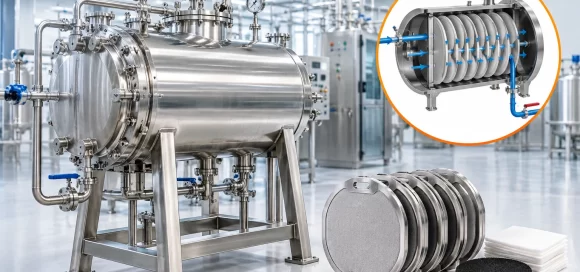
When plants search for Pharmaceutical Filtration Equipment Suppliers in India, the query is usually broader than what they actually end up buying. Filtration in a pharmaceutical or API plant covers several genuinely different technologies — plate filters, cartridge filters, membrane filters, pressure Nutsche filters — and the sparkler filter specifically remains one of the most widely specified because of how it balances filtration area against footprint. This guide narrows the broad category down to what a sparkler filter actually does, then covers what to check before ordering one.
Pharmaceutical Filtration Equipment Suppliers in India: The Main Categories
Before narrowing in on sparkler filters specifically, it’s worth knowing where they sit relative to the other filtration technologies a plant might need:
- Sparkler / horizontal plate filters — pressure filtration through a stack of plates, covered in detail below
- Pressure Nutsche filters — combine filtration and cake washing/drying in a single closed vessel, generally used where the filtered solid itself is the product; see our Pressure Nutsche Filter product page
- Cartridge and membrane filters — used for fine polishing filtration and sterile-grade clarification, typically downstream of a coarser filtration step; see our membrane filter holder product page
- ANFD (Agitated Nutsche Filter Dryer) — combines filtration and drying for API isolation; covered separately in our ANFD manufacturers guide
Most pharmaceutical and API plants end up needing more than one of these across different stages of the same process — a sparkler filter for bulk decolorization or clarification, followed by a finer cartridge or membrane stage before a sterile fill, for example.
Sparkler Filter Manufacturers in India: How the Filter Actually Works
A sparkler filter — also called a horizontal plate filter — works on pressure filtration through a stack of plates arranged with inlet and outlet ports typically at the bottom of the vessel. Filter media, commonly cellulose pads and sometimes carbon pads for decolorization work, sits between adjacent plates. Liquid is pumped through the stack under pressure; solids and impurities are captured on the media while clarified liquid passes through and exits via the outlet manifold.
Two flow configurations are available on most sparkler filter designs, and it’s worth confirming which one you’re being quoted:
- Forward flow — liquid enters and exits from the same side of the plate stack
- Reverse flow — liquid enters from the center of the plate arrangement, generally used to maximize product recovery from high-value solutions
At the end of a filtration cycle, air is typically passed through the plates to expel residual liquid from the filter cake before the plates are opened and the cake is collected — this step reduces product loss and shortens the overall cycle time compared to designs without an air-blow step.
Sparkler filters are widely used for decolorization in pharmaceutical manufacturing — passing a batch through carbon-pad-loaded plates to strip color bodies from an API solution — as well as for general clarification and polishing filtration ahead of crystallization or drying steps. Pragati Engineers’ stainless steel sparkler filter and sparkler filter filtration equipment product pages cover both forward and reverse flow configurations.
Buy Sparkler Filter in India: What to Check Before You Order
- Contact part material: confirm SS316 as standard for pharmaceutical and API applications; Hastelloy construction is available for highly corrosive solvent systems if your process requires it
- Filtration area vs footprint: ask for the rated filtration area per plate and total plate count for the model you’re quoted — this is the number that actually determines throughput, not the vessel’s overall size
- Zero hold-up design: if you’re filtering high-value APIs, ask specifically whether the design minimizes product hold-up in the vessel and piping between batches, since standard designs can leave meaningful product trapped in the system
- Forward vs reverse flow: confirm which configuration is being quoted and whether it matches your product recovery requirements
- Plate and gasket material: confirm compatibility with your specific solvents — gasket material that’s fine for aqueous processing can fail against certain organic solvents
- Safety features for solvent handling: spark-proof design elements matter if the filter will be used with flammable solvents in a classified area
Why Plate Count and Filtration Area Matter More Than Vessel Size
A common mistake when comparing quotes from different Sparkler Filter Manufacturers in India is comparing vessel dimensions rather than actual filtration area. Two filters of similar overall footprint can have meaningfully different plate counts and therefore different throughput — always ask for the rated filtration area in square meters, not just the number of plates, since plate diameter varies between manufacturers and directly affects the area each plate contributes. Our broader industrial filter press range covers related plate-and-frame configurations for higher-volume applications.
Why the Manufacturer’s Fabrication Quality Matters
A sparkler filter’s performance depends heavily on plate flatness, gasket sealing, and weld quality on the pressure vessel itself — a poorly fabricated stack leads to bypass around the filter media, which defeats the purpose of fine filtration regardless of how good the media itself is. Pragati Engineers fabricates filtration and process equipment in-house at its Ambala Cantt facility, with the same quality standards applied across our pressure vessel and reactor lines, including the equipment covered in our SS Reactor guide and Solvent Recovery Plant guide, both of which typically sit upstream or downstream of a filtration step in a real process line.
Frequently Asked Questions
What’s the difference between a sparkler filter and an ANFD?
A sparkler filter is a plate-and-frame pressure filter used mainly for clarification, decolorization, and polishing of liquids where the filtrate is the product. An ANFD (Agitated Nutsche Filter Dryer) is used where the filtered solid itself is the product — it combines filtration, washing, and drying of the solid cake in one vessel. They’re often used at different stages of the same process rather than as substitutes for each other.
What is a sparkler filter mainly used for in pharmaceutical manufacturing?
Decolorization is one of the most common uses — passing a batch through carbon-pad-loaded plates to remove color bodies from an API solution — along with general clarification and polishing filtration ahead of crystallization or drying.
Should I choose forward flow or reverse flow?
Reverse flow designs are generally chosen when maximizing product recovery from a high-value solution matters most. Forward flow is the more common default configuration. The right choice depends on your specific product value and process requirements — discuss this directly with the manufacturer before finalizing the order.
Does filtration area or plate count matter more when comparing quotes?
Filtration area matters more. Plate count alone doesn’t tell you the actual throughput, since plate diameter varies between manufacturers — always ask for the rated filtration area in square meters for a fair comparison across quotes.
Talk to Pragati Engineers About Filtration Equipment
Whether you’re evaluating Pharmaceutical Filtration Equipment Suppliers in India broadly, or specifically looking to buy a Sparkler Filter in India, share your process media, batch volume, and product recovery requirements with our engineering team. Contact Pragati Engineers to discuss your filtration requirements and request a quotation.