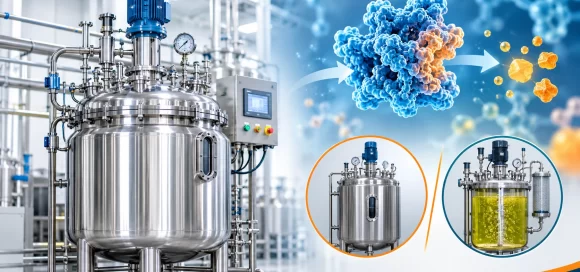
Search for “enzyme reactor manufacturers in India” and many of the results are companies that sell enzymes. That is a different business. An enzyme reactor is the stainless steel vessel where the enzyme does its work, and process equipment manufacturers build it.
This guide explains what an enzyme reactor is, how an enzymator differs from a bioreactor and which design factors matter. It also lists what to check before you place an order with any enzyme reactor manufacturer.
Key takeaways
- An enzyme reactor holds a substrate and an enzyme under controlled temperature, pH and mixing.
- In Indian pharma and biotech plants, a jacketed, stirred enzyme reactor is usually called an enzymator.
- An enzymator uses isolated enzymes. A bioreactor or bio fermenter grows living cells and needs aeration and stricter sterility.
- pH control, gentle mixing and uniform temperature protect enzyme activity.
- SS 316L is the usual choice for product contact parts.
What is an enzyme reactor?
An enzyme reactor is a vessel that holds a substrate and an enzyme under controlled temperature, pH and mixing so the enzyme can convert the substrate into the desired product. In Indian pharma and biotech plants, a stirred, jacketed enzyme reactor is commonly called an enzymator.
Enzyme manufacturer or enzyme reactor manufacturer: which one do you need?
The two terms sound alike but mean different things.
- An enzyme manufacturer produces the enzyme itself, usually as a powder or liquid made by fermentation.
- An enzyme reactor manufacturer builds the equipment in which that enzyme is used.
If you need the enzyme, look for an enzyme supplier. If you need the vessel, agitator, jacket and controls, you need an enzyme reactor manufacturer. Pragati Engineers builds the equipment, so you can pair our reactor with the enzyme your process uses.
Is an enzymator the same as an enzyme reactor?
In most Indian plants, yes. Enzymator is the common trade name for an enzyme reactor, especially the jacketed stirred vessel used for batch enzymatic conversion. If a quotation or tender says “enzymator”, “enzyme reactor” or “enzymatic reactor”, it is usually the same type of equipment.
Types of enzyme reactors
| Type | How it works | Typical fit |
|---|---|---|
| Batch stirred tank (enzymator) | Enzyme and substrate react in an agitated, jacketed vessel. The batch is drained when conversion is complete. | Most pharma and biotech batch processes |
| Continuous stirred tank | Substrate is fed in and product is drawn off continuously. | Steady, high-volume processes |
| Packed bed | Substrate flows through a bed of immobilised enzyme. | Continuous processes with immobilised enzyme |
| Membrane reactor | A membrane keeps the enzyme in the vessel while product passes through. | Processes where the enzyme must be retained |
This guide focuses on the jacketed stirred enzymator, the type most batch plants use.
Enzymator vs bioreactor: what is the difference?
Both are stirred vessels with a jacket, so they look alike. The difference is what they hold and what they must control.
| Point | Enzymator (enzyme reactor) | Bioreactor / bio fermenter |
|---|---|---|
| What it holds | Isolated enzyme, free or immobilised, and substrate | Living cells such as bacteria, yeast or fungi, and a growth medium |
| Main job | Convert a substrate into a product | Grow cells or make a product by fermentation |
| Aeration | Usually not needed | Often needed, with a sparger and dissolved oxygen control |
| Sterility | Clean and hygienic design | Strict aseptic design is often required |
| Key controls | Temperature, pH and mixing | Temperature, pH, dissolved oxygen and foam |
| Typical build | Jacketed, agitated vessel with pH dosing | Similar vessel with sparger, foam control and sterilisation |
A bio fermenter is a bioreactor used for fermentation, and the two words are often used interchangeably. If your process grows living cells, see our bioreactors and bio fermenters. If it uses an isolated enzyme, you need an enzymator.
How an enzymator works
- Charge: Water or buffer goes into the vessel.
- Heat: The jacket brings the liquid to the set temperature.
- Add substrate: The agitator mixes it in.
- Add enzyme: The enzyme is added either free or as immobilised beads.
- React: The agitator runs while the pH controller adds acid or alkali to hold the set point.
- Check and discharge: The operator samples to confirm conversion, then drains the batch. An immobilised enzyme stays behind on a bottom screen for the next batch.
Some reactions release acid as they proceed. Without pH dosing, the pH drifts and the enzyme slows down. This is why the control loop matters as much as the vessel.
9 design factors to check before you buy
1. Working volume and batch size
Size the vessel from your batch, and leave headspace for mixing and foaming. Many vessels are filled to about 70 to 80% of their total volume.
2. Agitator and mixing
Enzymes, and especially immobilised beads, do not like high shear. Ask for a low-shear impeller, a variable speed drive and baffles where needed. Good mixing removes dead zones, and gentle mixing protects the enzyme.
3. Jacket and temperature control
Each enzyme works best in a narrow temperature window. A jacketed vessel with a temperature sensor and controller holds that window. Direct steam in the jacket can overheat the wall and damage the enzyme, so many plants use hot water circulation instead.
4. pH control
Look for a pH probe, a controller and a dosing pump, with the dosing point placed where the agitator mixes it quickly.
5. Material of construction
SS 316L is the usual choice for parts that touch the product, because it resists chlorides and buffers better than SS 304. SS 304 can suit non-contact parts such as the jacket outer shell. Ask for the grade of every part in writing.
6. Enzyme retention
If you use an immobilised enzyme, the vessel needs a bottom filter or screen that retains the beads without blocking.
7. Seals, cleaning and hygiene
Look for a hygienic mechanical seal, polished internal surfaces and welds, a fully draining bottom valve and a CIP spray ball. These reduce carry-over between batches.
8. Instrumentation and safety
Ask about the level indicator, sampling valve, vent, pressure relief and control panel. Safety interlocks help when the plant runs automated cycles.
9. Documentation
Ask which documents come with the machine, such as drawings, material test certificates, surface finish records and calibration certificates. Your quality team will need them for qualification.
Common problems and how good design prevents them
| Problem | Likely cause | Design answer |
|---|---|---|
| pH drifts during the reaction | Slow or missing dosing control | In-line pH probe, dosing pump and good mixing at the dosing point |
| Enzyme activity drops | Local overheating or high shear | Controlled jacket temperature and a low-shear agitator |
| Immobilised enzyme is lost | Beads escape or break | Bottom screen and gentle agitation |
| Uneven conversion | Dead zones in the vessel | Baffles, the right impeller and the right fill level |
| Carry-over between batches | Crevices and poor cleaning | Polished surfaces, CIP spray ball and a fully draining bottom |
Where enzyme reactors are used
- Pharmaceutical intermediates and API steps that use an enzymatic conversion.
- Biotech process development and scale-up.
- Enzymatic hydrolysis and conversion in food and nutraceutical processing.
After the enzyme step, the product usually goes on to crystallisation, filtration and drying. Our guides to ANFD manufacturers in India and vacuum tray dryer manufacturers in India cover those steps.
How to choose among enzyme reactor manufacturers in India
A good manufacturer asks about your process before it quotes. Look for these points.
- Questions about your enzyme, substrate, pH and temperature window.
- Willingness to build to your URS for volume, material, agitator and instruments.
- Clear answers on enzyme retention, cleaning and documentation.
- Experience with pharma and biotech plants, backed by references. See our clients page.
- Spares, service support and export experience.
What to send with your enquiry
- The enzyme you use, and whether it is free or immobilised
- The substrate and the reaction you want to run
- Batch size and working volume
- Operating temperature and pH range
- Whether the reaction releases acid or alkali, and what you use to correct pH
- Material preference, SS 316L or SS 304
- Agitation and mixing needs
- Cleaning method and hygiene level
- Automation level and control panel needs
- Space limits and utilities available
- Documents your quality team needs
Why buyers choose Pragati Engineers
Pragati Engineers is ISO 9001:2015 certified and has manufactured process equipment in Ambala, Haryana since 1996. We build in SS 304 and SS 316L and export to South-East Asia and the Gulf. You can see our enzymator and bioreactors and bio fermenters pages, and our wider range of SS reactor manufacturers in India. For the full line, read our guides to API equipment in India and pharmaceutical process equipment in India. You can also review our about us, certificates and infrastructure pages before you enquire.
Get a quote for your enzymator
Share your enzyme, substrate, batch size, pH and temperature range. Our team will suggest a configuration and send a quotation.
- Call: +91-9896008557 or +91-7496970799
- Email: pragati@pragatiengineers.com
- Address: No. 87, Industrial Estate, Ambala Cantt, Ambala 133 006, Haryana, India
- Request a quote
FAQs about enzyme reactors and enzymators
What is an enzyme reactor?
An enzyme reactor is a vessel that holds a substrate and an enzyme under controlled temperature, pH and mixing so the enzyme can convert the substrate into a product.
What is an enzymator?
An enzymator is the common Indian trade name for an enzyme reactor, usually a jacketed, stirred vessel with temperature and pH control.
Is an enzymator the same as a bioreactor?
No. An enzymator uses isolated enzymes and does not usually need aeration. A bioreactor grows living cells and often needs aeration, foam control and stricter sterility.
What is the difference between an enzyme reactor and a bio fermenter?
An enzyme reactor runs a reaction with an isolated enzyme. A bio fermenter grows microorganisms to make a product by fermentation.
What is the difference between an enzyme manufacturer and an enzyme reactor manufacturer?
An enzyme manufacturer produces the enzyme. An enzyme reactor manufacturer builds the equipment in which the enzyme is used.
Which material is best for an enzymator, SS 304 or SS 316L?
SS 316L is the usual choice for product contact parts because it resists chlorides and buffers better. SS 304 can suit non-contact parts.
Why is pH control important in an enzyme reactor?
Each enzyme works best within a narrow pH range, and many reactions shift the pH as they run. A pH probe and dosing pump keep the reaction in range and protect enzyme activity.
What details should I send to enzyme reactor manufacturers in India?
Send the enzyme, substrate, batch size, temperature and pH range, material preference, agitation needs, cleaning method and the documents your quality team needs.
Can an enzymator be customised?
Capacity, material, agitator and instrumentation can be matched to your process. Share your batch size and operating conditions so the team can suggest a suitable configuration.
Does Pragati Engineers export its equipment?
Yes. Pragati Engineers manufactures and exports process equipment from Ambala, Haryana. Share your destination country with your enquiry so the team can plan packing and delivery.