
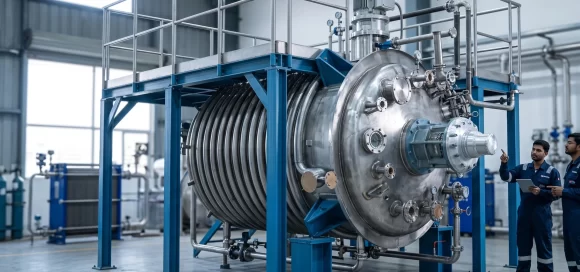
A stainless steel reactor is one of the most decision-heavy purchases in a pharmaceutical or chemical plant. It sits at the centre of the process, it is expensive to replace, and the wrong specification shows up later as poor batch consistency, cleaning validation headaches or corrosion. This guide walks through what actually matters when you specify and buy an SS reactor in India — the material of construction, jacket and agitation choices, sizing logic, and how to separate a capable manufacturer from a fabricator.
It is written for the people who own the outcome: process engineers, project and purchase managers, and plant heads specifying equipment against a URS.
What an SS reactor does in your process
A reactor (or reaction vessel) is a jacketed pressure vessel where you control temperature, pressure, agitation and reaction time to carry out a chemical or physical process. In pharma and API manufacturing it is used for reactions, crystallisation, mixing, blending and holding — often as part of a larger train that includes a heat exchanger and a solvent recovery plant. Because the vessel touches the product, its build quality directly affects purity, yield and your ability to clean and validate.
Material of construction: the first decision
The single most consequential choice is the material of construction (MOC). For most pharmaceutical and many chemical duties, the contact parts are built in stainless steel — commonly SS 316L for product-contact surfaces and SS 304 for structural or non-contact areas. The right grade depends on what the vessel will actually see: the chemistry, chloride content, temperature and pH of your process.
Where the process is aggressively corrosive and standard stainless steel will not survive, a fluoropolymer-lined vessel is the alternative. Pragati Engineers offers a Halar-coated agitated vessel for exactly these corrosion-sensitive duties. The practical rule: match the MOC to your worst-case chemistry, not your average case, and get the manufacturer to confirm grade against your process data before fabrication.
Jacket type: how you heat and cool the batch
The jacket is how you add or remove heat, and the type you choose is a trade-off between thermal performance, pressure rating and cost. The common options are a conventional (plain) jacket, a limpet/half-coil jacket for higher heat-transfer duty and higher jacket pressure, and a dimple jacket. If your process depends on tight, fast temperature control — many crystallisation and exothermic reactions do — the jacket specification is not a place to cut corners. A stainless steel jacketed tank follows the same logic where full reaction capability is not required.
Agitation: getting the mix right
Agitator selection is driven by the fluid you are mixing — its viscosity, whether solids are suspended, and how gentle or vigorous the mixing needs to be. Anchor, turbine, propeller and paddle designs each suit different duties, and the drive, seal type (mechanical seal versus gland) and RPM all follow from that. A vague “agitator included” line in a quote is a warning sign; a capable manufacturer will ask about your process before recommending an impeller and drive.
Sizing and design pressure
Size the vessel around your working batch volume with appropriate freeboard, not just the nominal capacity — overfilling kills mixing and risks carry-over. Design pressure and temperature should be set from process conditions with a safety margin, and the vessel should be built and tested accordingly. Because these figures are process-specific, share your batch size, operating pressure and temperature with the manufacturer and have them confirm the design against it rather than buying a generic size off a list.
Surface finish, cleanability and documentation
For pharma duty, internal surface finish matters because it governs how well the vessel cleans and how reliably you can validate that cleaning. Ask about the internal finish, crevice-free construction and drainability. Just as important is the documentation package — material certificates, weld and test records, and a design that supports your qualification activities. This paperwork is what turns a well-built vessel into an auditable one.
How to shortlist an SS reactor manufacturer in India
Fabricating a vessel and engineering a reactor are not the same thing. When you shortlist, look for a supplier that engineers to your process rather than selling a fixed model: one that asks about your chemistry, batch size and utilities before quoting, offers the MOC and jacket options your duty needs, and can supply the documentation your quality system requires. Our guide on how to choose the right pharmaceutical equipment manufacturer in India goes deeper on evaluating suppliers, and pharmaceutical process equipment used in modern manufacturing plants shows where the reactor fits in the wider train.
Pragati Engineers manufactures reactors and reaction vessels for pharmaceutical, API and chemical applications, including the stainless steel chemical reactor and stainless steel reaction vessel. You can see the full range across our chemical processing and API and bulk drug equipment categories.
Jacketed stainless steel reactor for pharma, API and chemical duties.
A simple specification checklist before you buy
Before you send an enquiry, have these ready so the manufacturer can design to your duty: the process chemistry and worst-case corrosion conditions; batch/working volume; operating and design temperature and pressure; required MOC grade; jacket type and heating/cooling medium; agitation requirements; internal surface finish; and the documentation your quality system needs. Supplying these upfront gets you an accurate, comparable quotation instead of a generic one.
Talk to Pragati Engineers about your SS reactor requirement
Share your process conditions and batch size, and our team will help specify the right reactor for your application. Contact Pragati Engineers or browse the SS reactor range to get started.
Frequently Asked Questions
What material is an SS reactor made of?
Product-contact surfaces are commonly built in SS 316L, with SS 304 used for structural or non-contact areas. The correct grade depends on your process chemistry, so it should be confirmed against your operating conditions before fabrication.
What is the difference between an SS reactor and a jacketed tank?
Both are jacketed vessels, but a reactor is designed for reactions under controlled temperature, pressure and agitation, while a jacketed tank is generally used for heating, cooling, mixing or holding where full reaction capability is not required.
Which jacket type should I choose for an SS reactor?
It depends on your heat-transfer and pressure needs. Plain jackets suit basic duties, while limpet/half-coil jackets deliver higher heat transfer and higher jacket pressure. Share your thermal requirements with the manufacturer so the jacket is matched to your process.
How do I choose the right SS reactor capacity?
Size the vessel around your working batch volume with adequate freeboard rather than the nominal capacity alone, and confirm design pressure and temperature from your process conditions with a safety margin.
What should I look for in an SS reactor manufacturer in India?
Choose a manufacturer that engineers to your process — one that asks about your chemistry, batch size and utilities before quoting, offers the MOC and jacket options your duty needs, and provides the material and test documentation your quality system requires.