
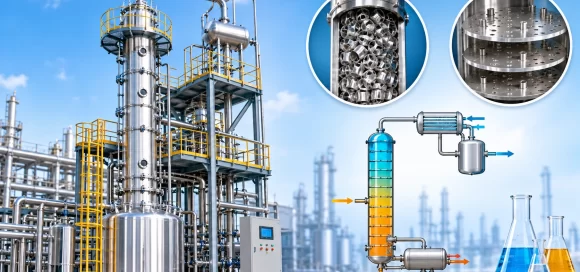
Most distillation problems are decided before the column is built. The solvent mix, the purity you need and the operating pressure choose the column type, its diameter and its height. If those inputs are wrong, no amount of extra height fixes the result.
This guide is for pharma and chemical plants that want a solvent distillation column or need to compare distillation column manufacturers in India. It explains how a column works, how packed and tray columns differ and what to check before you order.
Key takeaways
- A distillation column separates liquids by their boiling points using repeated vapour-liquid contact.
- Packed columns suit small diameters, vacuum, heat-sensitive and corrosive streams. Tray columns suit large diameters and feeds that can foul.
- Azeotropes, such as ethanol and water, cannot be separated past their azeotropic point by simple distillation.
- For flammable solvents, flameproof electricals, earthing and proper venting are essential.
- Send complete feed and purity data with your enquiry so the column is sized for your process.
What is a distillation column?
A distillation column is a tall vessel that separates a liquid mixture into its components by their boiling points. Heated vapour rises through packing or trays and meets descending liquid. Lighter components collect at the top, and heavier components collect at the bottom.
How does a distillation column work?
- Heating: The feed is heated in a reboiler or still pot and partly turns to vapour.
- Vapour rise: The vapour rises through the packing or trays.
- Condensation: The overhead condenser turns the vapour back into liquid.
- Reflux: Part of that liquid returns to the top of the column as reflux. The rest is drawn off as distillate.
- Contact: The reflux flows down and meets the rising vapour. Lighter components move up, and heavier ones move down.
- Bottoms: The heavier liquid is drawn from the base as bottoms.
More reflux gives better purity but uses more energy. The reflux ratio is the balance between the two.
Main parts of a distillation column
| Part | What it does |
|---|---|
| Column shell | Holds the packing or trays and withstands the operating pressure or vacuum |
| Packing or trays | Create contact between rising vapour and descending liquid |
| Reboiler or still pot | Heats the liquid at the bottom to make vapour |
| Condenser | Cools the overhead vapour into liquid |
| Reflux drum and divider | Collect the condensate and split it between reflux and product |
| Feed inlet and distributor | Introduce the feed and spread liquid evenly over the packing |
| Instruments | Measure temperature, pressure or vacuum, and level |
Packed column vs tray column: which one to choose?
Both separate liquids well. The right choice depends on your feed, your pressure and your column size.
| Point | Packed column | Tray column |
|---|---|---|
| How contact happens | Liquid spreads over packing as a thin film | Vapour bubbles through liquid held on each tray |
| Pressure drop | Low | Higher |
| Vacuum operation | Well suited | Possible, but pressure drop matters more |
| Heat-sensitive products | Low liquid hold-up helps | Higher hold-up means longer heat exposure |
| Corrosive streams | Easy to use plastic or ceramic packing | Needs corrosion-resistant trays |
| Fouling or solids in feed | Can block the packing | Handles fouling better |
| Large diameters and high liquid loads | Liquid distribution becomes harder | Better suited |
| Cleaning and inspection | Packing may need removal | Access through manways |
In short: a packed column for pharma solvents is often the better choice when the column is small to medium in diameter, runs under vacuum or handles heat-sensitive or corrosive liquids. A tray column is often better for large diameters, high liquid loads or feeds that can foul.
Packing and tray types
- Random packing: Rings and saddles poured into the column. It is low in cost and common in smaller plants.
- Structured packing: Corrugated sheets stacked in layers. It gives the lowest pressure drop and high efficiency, at a higher cost.
- Sieve trays: Perforated plates. They are simple and low in cost.
- Valve trays: Plates with movable valves. They handle a wider range of vapour loads.
- Bubble cap trays: Caps over risers. They work at low vapour rates and are used less often today.
Distillation column for solvent recovery in pharma plants
Pharma plants use large volumes of solvents such as methanol, ethanol, isopropanol, acetone, ethyl acetate, toluene and hexane. After a reaction or crystallisation step, the used solvent is distilled so it can be reused. This saves solvent cost and reduces waste.
A distillation column sits at the heart of a solvent recovery plant. It lifts the purity of the recovered solvent well above what a simple still can reach. Our guide to solvent recovery plant suppliers in India explains how the full plant is arranged.
Three points matter most for solvent duty.
- Azeotropes: Some mixtures cannot be separated past a fixed composition. Ethanol and water, for example, form an azeotrope at about 95.6% ethanol by weight at atmospheric pressure. Isopropanol and water also form one. Reaching higher purity needs a different method, such as an entrainer or pressure change.
- Vacuum operation: Running under vacuum lowers the boiling point, which protects heat-sensitive materials.
- Flammable solvents: Most recovered solvents are flammable. The column needs suitable electricals, earthing, vents and pressure relief.
The solvent often comes from a reaction vessel upstream. Our range of SS reactor manufacturers in India covers that step.
8 design factors to check before you buy
1. Feed and solvent mix
List every component in the feed, with its proportion and boiling point. Note any water, salts or solids. This decides the column type and whether an azeotrope blocks your target purity.
2. Purity target and reflux ratio
Higher purity needs more stages or more reflux. Tell your supplier the purity you need for the recovered solvent, so the column is neither undersized nor oversized.
3. Column diameter and height
Diameter comes from the vapour load, and it must be large enough to avoid flooding. Height comes from the number of separation stages needed. For packing, this is the packed height per theoretical stage (HETP). A supplier should size both from your data.
4. Packing or tray type
Pick the internals to match the duty. Structured packing gives low pressure drop for vacuum work. Trays suit feeds with solids. Ask the supplier why they recommend one over the other.
5. Material of construction
| Grade | Strength | Typical use |
|---|---|---|
| SS 304 | Good general corrosion resistance, lower cost | Neutral solvents and non-aggressive mixtures |
| SS 316L | Better resistance to chlorides and acidic streams | Pharma duties, chlorinated solvents and frequent cleaning |
Strongly corrosive streams may need special linings or alloys. Confirm the grade for every wetted part.
6. Vacuum or atmospheric operation
State your operating pressure. A column built for vacuum needs the right flanges, gaskets and a vacuum-tight shell, and the vacuum system must match the load.
7. Condenser and heat load
The condenser must handle the vapour load at your solvent’s condensing temperature. Low-boiling solvents often need chilled water or brine. See our condenser heat exchanger page and our guide to heat exchanger suppliers in India.
8. Safety for flammable solvents
Ask about flameproof motors and instruments, earthing and bonding, nitrogen blanketing, pressure relief and vent condensers. Tell the supplier the hazardous area classification of your plant.
Common problems and how good design avoids them
| Problem | Likely cause | Design answer |
|---|---|---|
| Flooding | Column diameter too small or internals blocked | Size the diameter from the vapour load and keep the feed clean |
| Weeping on trays | Vapour rate too low for the tray | Choose the right tray type and operating range |
| Poor separation | Too few stages or too little reflux | Size the height and reflux from the purity target |
| Foaming | Surfactants or contaminants in the feed | Pre-treat the feed and allow enough vapour space |
| Uneven liquid flow in packing | Poor liquid distributor | Use a well-designed distributor and redistributors |
| Fouling of internals | Solids or scale in the feed | Filter the feed, or use trays with easy cleaning access |
| Unstable vacuum | Leaking joints | Use proper gaskets and test the column for tightness |
What affects the cost of a distillation column
Cost depends on your configuration, so no single figure fits every buyer. These factors have the biggest effect.
- Column diameter and height.
- Packing or tray type.
- Material of construction.
- Vacuum rating and operating pressure.
- Size of the condenser and reboiler.
- Instruments, automation and safety fittings.
A quote based on your own data is the fair way to compare suppliers.
How to choose among distillation column manufacturers in India
A good manufacturer asks about your process before it quotes. Look for these signs.
- Questions about your feed, purity target and operating pressure.
- A clear reason for choosing packing or trays.
- Experience with pharma and chemical solvent duties, backed by references. See our clients page.
- Willingness to build to your URS for diameter, height, material and instruments.
- Ability to supply the wider line, such as reactors, condensers, heat exchangers and solvent recovery.
- Documents, spares and service support after dispatch.
What to send with your enquiry
- The solvent or mixture, with every component and its proportion
- Feed rate in litres per hour or per batch
- Purity you need for the distillate and the bottoms
- Operating pressure, atmospheric or vacuum
- Solids, water or salts present in the feed
- Material preference, SS 304 or SS 316L
- Heating source and cooling water or brine available
- Hazardous area classification of the plant
- Automation level and control panel needs
- Space and height limits
- Documents your quality team needs
Why buyers choose Pragati Engineers
Pragati Engineers is ISO 9001:2015 certified and has manufactured process equipment in Ambala, Haryana since 1996. We work in SS 304 and SS 316L and export to South-East Asia and the Gulf. Our range includes solvent recovery plant systems and the equipment around them. For the full line, read our guides to API equipment in India and pharmaceutical process equipment in India. You can also review our about us, certificates and infrastructure pages before you enquire.
Get a quote for your distillation column
Share your solvent mix, feed rate, purity target and operating pressure. Our team will suggest a configuration and send a quotation.
- Call: +91-9896008557 or +91-7496970799
- Email: pragati@pragatiengineers.com
- Address: No. 87, Industrial Estate, Ambala Cantt, Ambala 133 006, Haryana, India
- Request a quote
FAQs about distillation columns
What is a distillation column?
A distillation column is a vessel that separates a liquid mixture into its components by boiling point, using repeated contact between rising vapour and descending liquid on packing or trays.
How does a distillation column work?
The feed is heated, and the vapour rises through the packing or trays. The condenser turns it back into liquid, and part returns as reflux. Lighter components collect at the top, and heavier ones collect at the bottom.
What is the difference between a packed column and a tray column?
A packed column uses packing material to spread liquid into a thin film, giving low pressure drop. A tray column holds liquid on horizontal plates through which the vapour bubbles. Packed columns suit vacuum and small diameters, and trays suit large diameters and feeds that can foul.
Which is better for pharma solvents, packed or tray?
It depends on the duty. A packed column is often chosen for pharma solvents because it works well under vacuum and suits heat-sensitive or corrosive streams. A tray column is often better for large diameters or feeds with solids.
What is reflux in a distillation column?
Reflux is the part of the condensed liquid that returns to the top of the column. It improves separation. A higher reflux ratio gives better purity but uses more energy.
Which material is best for a solvent distillation column?
SS 316L is the usual choice for pharma duties because it resists chlorides and acidic streams. SS 304 can suit neutral solvents. Very corrosive streams may need special linings or alloys.
Can a distillation column be used for solvent recovery?
Yes. A column raises the purity of used solvent so it can be reused. It is the main purification unit in a solvent recovery plant.
Can a distillation column separate an azeotrope such as ethanol and water?
Not past the azeotropic point by simple distillation. Ethanol and water form an azeotrope at about 95.6% ethanol by weight at atmospheric pressure. Higher purity needs a different method, such as an entrainer or a pressure change.
What details should I send to distillation column manufacturers in India?
Send the solvent mix with proportions, feed rate, purity target, operating pressure, solids or water in the feed, material preference, utilities available and the hazardous area classification.
Can the column be customised?
Diameter, height, internals, material and instruments can be matched to your process. Share your feed data and purity target so the team can suggest a suitable configuration.
Does Pragati Engineers export its equipment?
Yes. Pragati Engineers manufactures and exports process equipment from Ambala, Haryana. Share your destination country with your enquiry so the team can plan packing and delivery.